Our first adventure at Coral Bay is the Manta Ray Swim Tour with Ningaloo Reef Dive & Snorkel.
An 8.15am meet at the tour office and fit-out with wetsuits hoping to find one that didn’t look too much like a seal and attract sharks. We already had our rashie’s and swimmers with us but wetsuits make for increased buoyancy and any help with that is welcome, especially in deep water.
After a bad wave bombing experience while snorkelling on our last visit to Vanuatu, I chose to have a practice in the warm, shallow waters of our local Bill’s Bay but I was still a little apprehensive as the continuing Southerly wind was predicted to create choppy waters and a fair swell out in the more open water.
Two mini-buses took our group out to the marina where we boarded our boat and headed out to the reef through a narrow navigation channel. The wind had already picked-up blowing small waves across the surface of the sea making it harder to identify the reef below. The team know these waters well though and we were soon mooring to the buoy at a dive site called Blue Maze, named for its shades of blue created by the varying depths of water and the white sand on the sea bed.
Blue Maze
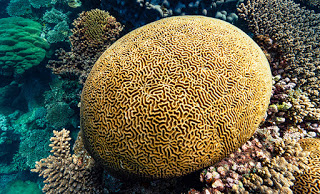
Following those choosing to scuba dive, we slid into the water quickly realising it wasn’t that warm and grateful for having the wetsuits. Unlike the tropical waters of the Great Barrier Reef, Ningaloo Reef is sub-tropical and along with that classification is much cooler water, less colourful and mostly hard coral species. Here there are fewer forms of coral (200 compared to the 500 of the Great Barrier Reef) but blue-tipped staghorn, brain, boulder, mushroom, cabbage and plate corals are common.
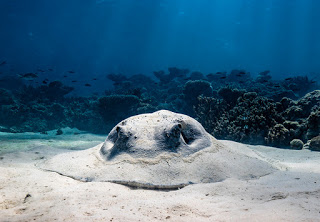
Visibility was around 10-metres but much of the deeper reef lacked colour as the level of sunlight faded. Still, there was plenty to see with schools of tiny bright blue fish, Parrot fish, blue and yellow Dory’s, orange Nemos sheltering in the safety of their favourite sea anemones, Angel fish, Maori Wrasse, Box fish, Butterfly fish, and a Stingray that Peter Wandmaker, the resident professional underwater photographer, dived down to photograph. Not quite on the scale of the Great Barrier Reef but impressive all the same.
I have to admit that the choppy water and strong current at times left me feeling a little uneasy and I opted for the assistance of one of the tour guides with a tow-float – I still hadn’t shaken my Vanuatu experience. But I persisted, I didn’t want to miss the opportunity of later snorkelling with the Manta Rays further up the coast. However it was cold and my back was starting to ache. Fortunately it was time to head back to the boat – everyone had been in the cold water long enough.

Once onboard everyone was shaking from the cold and even a hot cup of coffee didn’t appear to be helping me warm-up, nor did a hoodie. I decided it wise not to continue any further and risk the cold water putting my back into spasm again. I was disappointed to miss the opportunity to swim with the Mantas but safety comes first and at least Catherine had other people in the group to snorkel with.
With most of our group warming-up and the divers returned, our boat headed North to the lagoon where the Manta Rays were expected to be found. We arrived as several other boats were on the lookout and the spotter plane was circling above giving directions to follow. It was pretty hectic chasing the fast swimming rays and no sooner had one boat sighted a ray and dropped their snorkellers, the Manta they had located changed direction.

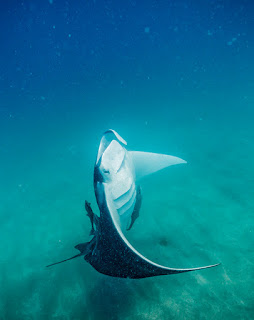
The larger female Manta Rays, almost 4-metres tip to tip, were being closely followed by the males but she was just interested in food and followed a feeding pattern where she swims in a line filtering plankton before performing a barrel roll and returning back along the line again and again.
I was watching with some amusement from the fly deck as the lead snorkeler kept showing the change of direction while everyone tried to keep up. And the boat captains were having just as much fun trying to position one group ahead of the line feed and recover the other while keeping a close eye on the snorkelers from other boats, communicate with the spotter plane and the boat crew.
The wind had increased even more as had the swell but Catherine at last got to see two Manta Rays, one line feeding and the other doing barrel rolls before it was decided to call it a day chasing these huge creatures and head to calmer water for lunch.
Sharks!!
The final snorkel and dive site proved to be the most productive for spotting larger fish though Catherine too had now chosen to stay onboard and keep warm. Ten grey reef sharks were circling around the reef giving our photographer some great shots.
A leisurely cruise back to the harbour and another warming coffee rounded a great day out on the reef. The crew were excellent and made sure everyone had an amazing and safe experience. There are few places in the world where Manta Rays can be found so close to shore and have an almost guaranteed opportunity to swim with them.
Coral Bay here in the Northwest of Western Australia is one such place and if you are ever in this area an adventure with Ningaloo Reef Dive & Snorkel is a must but we would recommend earlier in the dry season when the water is a little warmer and less windy too.
For more details visit: Ningaloo Reef Dive & Snorkel
A special thanks to the highly talented Peter Wandmaker for his excellent underwater photography on our trip. His photographs taken on the day are published on this post.
For further information:
www.ocmedia.com.au
Instagram: @oceancollectivemedia
 Discovery Down Under