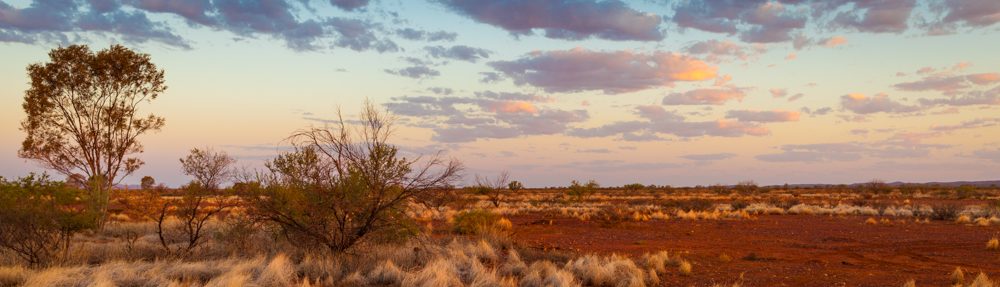
We’ve finally made it to another of our Bucket List destinations. Over the next five-days we’ll be exploring Karijini National Park and its spectacular gorges.
The drive from Port Hedland towards Karijini on the Great Northern Highway is one of the busiest Road Train routes in Australia. Mostly carrying iron ore from mines to the south, economics mean a more direct train line is not practical. The trucks are running 24×7 and travelling faster than the 100KMH limit for towed vehicles in Western Australia. That requires caravans to give way to rear approaching traffic and keeping as far to the left as possible as Road Trains approach from ahead. A quick call out on UHF 40, pulling over as far as possible and slowing a little is always appreciated.
Arriving at Karijini National Park is initially a little let-down. The drive into Dales Gorge, our camp location, provides no hint as to what awaits. Virtually flat with mixed scrub, spinifex grass, lots of dust and distant hills give nothing away despite the fact that our campsite is just a few hundred metres from one of the best and easiest to access gorges.
The Sky at Night
An unexpected treasure currently in Dales Gorge is an astronomy viewing experience by the highly knowledgeable and equally entertaining Phill Witt of Remtrek Astronomy. This 2.5-hour guide to the night sky is a must on a visit to Karijini with warm evenings and an absence of light pollution that otherwise spoils the view of the heavens – even with the high and bright moon on our visit, which, as it happened, had its benefits.
Phill will have you laughing right from the start with his quick wit and visitor involvement while describing the night sky and its many wonders. You’ll soon be able to identify the Southern Celestial, which will guide you towards the south, our closest stars outside of our solar system – Alpha Centauri and Alpha Proxima as well as many of the signs of the Zodiac – some clearly more obscure than others.
Then the real fun begins as Phill trains three telescopes, cutely named Baby Rex, Middle Rex and Big Rex, onto Alpha Centauri. With the naked eye we see only one star but through the telescopes Alpha Centauri is clearly not one but two stars – Alpha Proxima being the other.
Next is just a faint blur to the eye, known as the Omega Centauri globular cluster, but the telescopes reveal a minute patch of sky comprised of approximately 10-million brilliant stars 16,000 light years away. A little closer to home is the coloured Jewel Box at a mere 6,440 light years.

A mind blowing view of Jupiter with its Great Red Spot and moons followed by the spectacular angled view of Saturn and its rings only 10-metres deep. For such relatively affordable telescopes the detail and quality is amazing. Finally a close-up view of the moon, where Phill will capture the image on you own mobile phone, Samsung so obviously preferred by Phill, but just as good on an iPhone.
A very educational and entertaining evening and what better than a chocolate Milky Way bar to take away as a reminder of that enormous glowing vision we get to see in these special Dark Sky locations in Australia.

Dales Gorge campground is conveniently positioned close to several of Karijini’s highlights and our first exploratory walk was just several hundred metres to Circular Pool Lookout. Best explained as a jaw-dropping moment and a place you will here the word ‘wow’ spoken in many languages. The high contrast light makes photography difficult here – you’ll have to take our word for it.
Circular Pool is an enormous circular hole carved out of the ground by water over countless years at the head of a long gorge with vertical rock faces comprised of iron bearing sandstone, dolomite, shale and traces of blue asbestos. A trail that drops steeply into the gorge is one we shall be exploring later in the week.

A brief trial mine of asbestos proved uneconomical due to the narrow bands where it is exposed. It is, however, a risk to those exploring the gorges and the National Parks Service have placed warning signs advising of the danger and to leave well alone.
We followed the gorge rim passing Ghost and Spotted gum trees and mounds of needle sharp Spinifex grass. Sitting or falling on one of these is bound to be a highly uncomfortable and memorable experience. Still, they look amazing with their light yellow colour contrasting with the deep orange soil we’re surrounded by. From the rim you get an idea just how old some of these rocks are by the number of alternating coloured layers that reach over 100-metres to the base of the gorge. It is believed the oldest rocks date back 1.5-billion years – long before complex life forms existed on our planet.
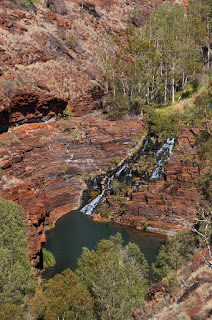
Our rim walk led us to the Fortiscue Falls Lookout, which during the wet season is a raging torrent of water, but today, towards the end of the dry season, is a pleasant tumble of white silky veils. Fortiscue Falls is unusual in that the fall is comprised of regular rectangular blocks of sandstone layered like a staircase. It makes reaching the pool at the base that much easier to access but unfortunately that means, yet again, this is a place for people to swim, to cool-off after a long hot walk and pollute the water with suncream.
As I’ve mentioned before, to me swimming in a National Park is just wrong but it is the Australian way. Any hope of getting a half-decent photograph of this natural wonder is going to require some judicial editing to remove people from the shot.
To reach the falls requires little effort as long as you are comfortable climbing 286-steps down the cliff-face. That of course means a return trip of the same number of steps to warm you up again after that cooling dip. There are, however, two paths that lead further from here, one crosses the falls and follows the gorge downstream and the other, which we will follow leads to Fern Pool.

Having been surrounded by high cliff walls it comes as a surprise when you walk just metres from the falls into a peaceful wooded glade full of bird song and the screech of fruit bats. All of a sudden everything is bright green with tall grasses, paperbark trees and maiden hair ferns clinging to the damp stone below giant fig trees.
The short walk leads to an opening in the trees where a small waterfall tumbles into a large, clear pool of cool water. It is such a stark contrast to Fortiscue Falls and the surrounding gorge. It’s also equally as attractive to swimmers. The wet season will, however, provide a very different view of this peaceful setting – just a wild, turbulent body of water feeding Fortescue Falls.
The second path leading from Fortiscue falls is one we will follow later in the week. For now, though, we’ll just be glad to reach the summit of all those steps, cool-off and chill-out for the rest of the afternoon prior to Happy Hour.
 Discovery Down Under