No, this isn’t the title to a romantic novel or a celebration of the 50th anniversary of the NASA Lunar Landing, this is an unusual but entirely natural phenomenon here on the coast of Broome, Western Australia.
Cameras at the Ready
After the sun has passed beyond the horizon and the Milky Way is lighting-up the sky, a crowd can be found gathering along the coast with cameras in-hand eagerly waiting in anticipation of this 2-3 times a month event between March and October, which falls mostly, and conveniently, during the dry season.
Moonrise over Roebuck Bay – Broome
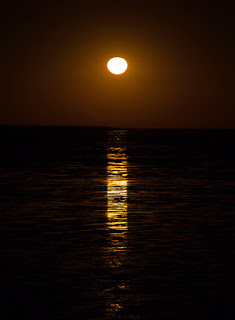
At precisely the advertised time a dim glimmer on the black horizon begins to glow and camera shutters start to clatter. Within minutes a deep orange crescent begins to appear, slowly expanding into a glowing ball and casting bright streaks across the wet tide exposed mud flats. This isn’t a sunrise, though it could easily be mistaken for one, this is likely the strangest moonrise you’ll witness, this is the Staircase to the Moon.
Due to the extreme tides, which are among the largest in the world, and a shallow bay, the tide reaches out for several kilometres leaving the extensive mud flats high and dry during the low tide. As the moon begins to rise it’s white reflected light from the sun passes side-on through the Earth’s shallow atmosphere filtering the blue hues and leaving just the yellows and reds that create our orange moonrise. And as the moon continues to rise higher into the sky the moonlight takes a shorter path through the atmosphere and less colour is filtered rendering the moon its more familiar blue/white hue.
Almost there…
Photographing the moon is rarely easy. For one it is much smaller than it appears in your viewfinder but it is also extremely bright against the blackness of space, bright enough that it can be clearly seen during daylight hours. Secondly the dark sky misleads camera meters resulting in overexposure of the moon and only a very limited, and very expensive, number of cameras are able to record such extreme contrast.
Staircase to the Moon
Unfortunately on our visit it was sufficiently windy that, even with a sturdy tripod, the long lens moved enough to blur many of my attempts to photograph this phenomenon. Hopefully we may get a second chance later on our trip as we head further west.
Pronounced ‘Der-bee’ not ‘Dar-bee’ as in the originating English town name, Derby is a small town on the Kimberley coast between Darwin and Broome. Sitting at the edge of an enormous estuary, Derby has the second highest tides in the world reaching as much as 11.8-metres during King tides. And that, unfortunately, is all it really has going for it apart from the sunsets over the Indian Ocean.
Loch Street is lined with Boab trees where the Tourist Information Centre is located. Very helpful staff unless you arrive 15-minutes from closing time when you can expect to be made to feel somewhat unwelcome.
Running parallel on Clarendon Street is Jila cafe where you can enjoy fresh cakes and pastries as well as Italian style meals in the evening as we did. There’s also an interesting collection of books to read while sipping an iced coffee and several Italian motorbikes on display for those with a two-wheel bent.
Sitting on the estuary means mud flats and here in Derby they are enormous, literally as far as you can see to the east, west and north. Our caravan site backed onto the western edge of the flats with very little to see but at least we were mostly sheltered from the wind with some well established trees.
Derby Jetty at sunset
A loading terminal at the jetty just north of Derby town centre can be reached along Jetty Road and is a popular spot to watch the sun set or fish for dinner, as long as the crocodiles don’t beat you to the catch.
Also by the jetty is the Derby Wharf Restaurant serving table meals as well as take-aways such as the local fish & chips. However, we made the mistake of eating here one evening and were served, after a very long wait, with over-cooked fish and chicken dishes. And add to that the elderly ‘entertainer’ who can neither sing or play his guitar too well through his distorted sound system. Normally an evening musician would get a clap or some form of applause after each tune but here you could hear a seagull fart several hundred metres away.
Things to do
Tourist points of interest are the Old Gaol and a little further away the Prison Tree where, supposedly, those not conforming to the rules of the time were held captive in the hollow of the Boab tree trunk. And secondly, not forgetting the longest cattle trough ‘south of the equator’ all 120-metres of it. Those with a pastoral background may find this a little more captivating than us.
Aboriginal Man
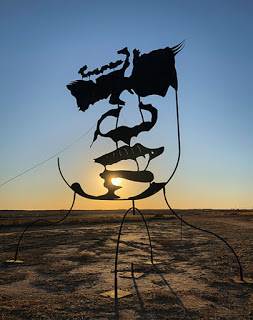
One saving grace is the clever art form close to the Kimberley Entrance caravan park. It’s not immediate what it is or what it represents but wait until closer to sunset when people armed with cameras arrive and you’ll soon discover the hidden image. Impressive what can be created with a few discrete pieces of steel.
Pretty much everything else was either closed, closing or closed down. The local swimming pool displayed its open swimming times but the gates were firmly locked and the IGA supermarket gave the impression of a store ransacked in a riot with largely empty shelves.
Derby, it’s a town not just asleep during the busy tourist season, it’s in a coma.
A very early start today to meet with our tour at 6.15am but at least we get to see a WA sunrise as compensation. We had been warned that we were in for a rough ride along the rutted gravel road to our destination and it was, very rough. But getting to see special places like today’s in Australia is rarely easy, or comfortable, but worth it.
Purnululu – North
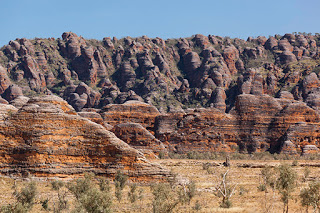
Today we are heading out to Purnululu National Park, a World Heritage Site, previously, and more popularly, known as the Bungle Bungles. Little known or explored by Europeans until an ABC TV programme filmed in the area in 1983, when public and scientific curiosity was aroused. What had created these spectacular black and orange stripped, beehive-shaped rock domes?
The Bungle Bungle Range has been on our must visit list for many years and today, finally, we were not only going to see them but also walk among them. And more…
Rough Ride
Our 4WD bus didn’t look in the best shape, but then what would after 450,000KM on dirt roads. It still had life in it and apparently coping better with the Bungles than the new bus that was shedding nuts, bolts and passenger seats. But an hour of bone-jarring ruts, bumps and floodways, past ghost gums, mounds of spinifex, dry creeks, feeding wallabies and moonscapes, got us to the Purnululu Visitor Centre. We still had 30-minutes of rough road ahead of us to reach our destination but everyone was ready for a break and a chance to stretch and put joints and false teeth back in place.
The Domes
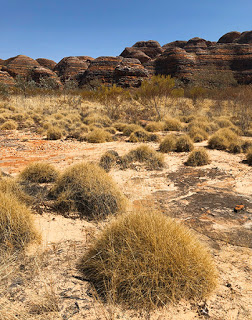
There are some enormous escarpments along the route, moonscape-like hills and green valleys full of ghost gums, not what we had expected to see from all the published photographs, but these were just a teaser to what we finally started sighting – the characteristic stripped domes of the Bungle Bungles. And it wasn’t long before we were enjoying our morning tea break stood right in front of these amazing, other worldly domes.
Purnululu National Park – The Bungle Bungles
What, on first appearance looks to be different layers of rock, the domes are actually comprised entirely of almost white sandstone. The orange bands are layers where water from the wet season has seeped to the surface taking iron along with it and rusting where it is exposed to oxygen. This is the same process that causes the classic red earth and rock of much of the north and west of Australia. The black bands are also the result of water seepage but have a higher moisture content allowing Cyanobacteria to grow on the surface. These are the same single cell life forms that were known to exist 3.5-billion years ago, one of the earliest known forms of life on this planet.
Spinifex and Beehive Domes
You have to ask where this sandstone came from in the first place, after all sandstone was once just loose sand formed by the sea, glaciers or rivers. A clue is visible in narrow bands of the rock walls. In this case pebbles of an ancient river are embedded in the sandstone showing this area has had fast flowing water for millions of years. But in turn those pebbles were at one time themselves, chunks of rock that tumbled from ancient cliffs into flowing water. Research suggests the rock that forms the Bungles is between 350 and 400-million years old and their current form has been created over the past 20-million years.
Our first walk took us around many of the sandstone domes along a dry creek for a close-up view where our guide, Steve, explained the process that created them and the related human history. They look delicate, and in places they are but the Cyanobacteria is helping bond the sandstone surface slowing its erosion. Needless to say we were all looking through our viewfinders for the best place to take a photograph as we continued our walk.
Domes Walk – Riverbed
The Aborigines have known of these features for tens of thousands of years and many areas are held sacred by them but the first Europeans that passed through on cattle droves thought them nothing remarkable. By contrast, in 2003, Purnululu was added to the UNESCO World Heritage List joining such elite company as the Grand Canyon, Yellowstone and Yosemite National Parks in America, the Dolomites and Mount Etna of Italy and, of course, Australia’s eleven other listed sites including the Great Barrier Reef.
Cathedral Gorge
Part way along our walk the path divides leading to Cathedral Gorge, a place of outstanding proportions. Walking beside a deep but dry riverbed cut by rushing water, we followed a narrowing gorge with orange sandstone walls rising over 200-metres above us and climbing several sets of steel steps before the enormous scale of Cathedral Gorge was revealed.
Cathedral Gorge
It is hard to convey the scale of this place from a photograph – you really need to be standing here yourself to appreciate just how big this water cut gorge is.
You will certainly have seen it on TV or any Qantas flight where the heart tugging ‘I still call Australia home’ song is played from the gorge along with the entire Sydney Symphony Orchestra.
Echidna Chasm
The day was still young and following lunch we were off again, this time to the north and another hour on the gravel road. Our next destination is Echidna Chasm and what a remarkable place it is and absolutely worth the discomfort.
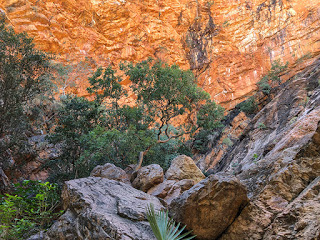
The path is a little tough on the ankles as it clambers over large river rocks and boulders beneath towering cliffs lined with Livistona trees. However, these cliffs were entirely different from the domes we had left behind. The entire area is comprised of conglomerate, a mixture of different size pebbles and boulders solidified in place by sandstone. Where exposed to oxygen it looks much like orange-coloured concrete and is almost as hard.
Cathedral Gorge entrance
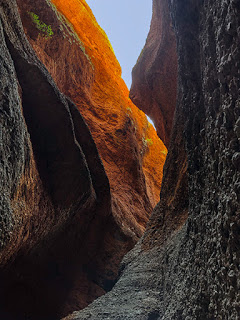
The chasm quickly narrows and darkens with slits of light from above giving the upper reaches a warm glow. Several large chunks of rock have fallen but remain precariously wedged between the chasm walls and further in, just as it looks as though the way is blocked by huge rock falls, you can weave your way around them, up steps and finally arrive in a round amphitheater with unusually high humidity.
The return walk is just as impressive as you work your way closer to daylight and the dry heat of the sun. We hadn’t heard of this chasm before but so glad we got to see it.
Lookout!!
As we headed back towards camp on another long, rough drive, Steve had a treat for us. We stopped at Steve’s favourite viewpoint and what a impressive place it was with a 360-degree view across a valley with spear and spinifex grasses, ghost gums and orange cliffs glowing in the setting sun. The steep but short walk to the top was worth every step.
Kungkalanayi – Lookout
Dinner One last treat was waiting for us as we got back to camp. Included with the full-day tour was dinner, which tonight was three large pieces of eye fillet, cauliflower and broccoli bake, sautéed potatoes and two salads with apple pie and ice cream to follow along with the great company of our fellow tour group.
Of all the tours we have done on our trip so far, this one is right up there with the best. You do need to be quite fit, wear suitable enclosed walking shoes and can handle the rough drive and uneven paths, but it is worth every ache you’ll have the following day.
An early start today for an organised tour of El Questro Gorge, Zebedee Springs and an afternoon river cruise on the Chamberlain River.
Our guide, Emma, takes our group of four by 4WD 30-minutes along gravel roads and water crossings to reach the start of the El Questro Gorge trail. It’s only 8.30am and pleasantly cool as we start the rough track through savannah woodland towards the start of the gorge.
Like much of the surrounding 1-million acres of this remote wilderness park, El Questro Gorge is comprised of King Leopald Sandstone, 1.8 billion years old and predating multicellular life. It is an extremely hard form of stone, which splits easily into square blocks before tumbling down into ravines, gorges and valleys. It is responsible for much of the layered hills and escarpments typical of the Kimberley.
Livistona Palms
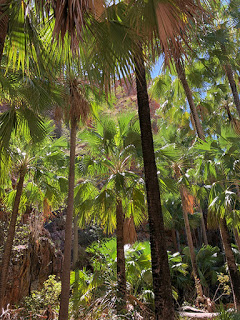
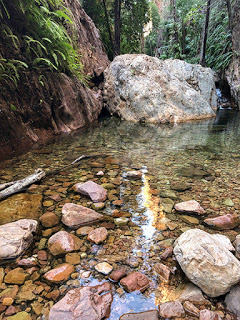
Here, over tens of thousands of years, water has penetrated cracks in the rock creating the gorge and its micro climate shaded from much of the intense sun. It is full of life. Towering Livistona trees line the creek that flows from the gorge backed by bright orange sandstone cliffs. Ferns thrive in the shade and provide habitat for small lizards, insects and frogs. Harmless Golden Tree Snakes are common but recent sightings of the highly venomous Death Adder means keeping a close eye on where you place your feet.
Emma showed us the unusual trick played by Spear Grass during the wet season. Water causes the seed spikes to twist around and dig into the soil. It’s a peculiar sight to see a plant moving of its own accord. But then this is a country of extremes and diversity and it takes this type of unusual action to survive.
Ochre Demonstration
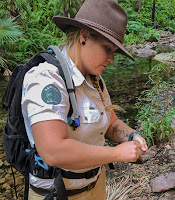
A little further on Emma reached for three stones hidden among tree roots by a pool. She had collected samples of ochre used by aborigines for rock art and ceremonial body paint. Orange, yellow and white ochre are rubbed against stone to produce a fine powder, mixed with water and painted directly onto rock or their skin. Charcoal is the final ingredient and is used to produce a deep black completing the four colours used in the aboriginal flag.
Deeper into the gorge we came to an abrupt stop where an enormous boulder had fallen reaching out to both sides of the gorge wall and blocking any further progress. A small waterfall fed the clear pool where we stopped to take a few photographs before heading back the way we came.
El Questro Gorge
It is definitely a walk requiring suitable shoes or boots for clambering over rocks and boulders and a walking pole is recommended.
Morning Tea
A short drive takes us to a pleasant riverside rest area where a few brave people were having a swim and the less brave took to the riverbank fishing for barramundi. Beside us stands, if that is the correct word, an enormous boab tree hit by lightning during the last wet season, which literally blew it apart. Boab trees store a lot of water and the lightning strike would have instantly turned the water to steam ripping the tree apart from the inside out. What remains is a mass of fibrous sheets, each being similar to the rings of a tree. An unusual feature of the boat’s survival technique – just beneath the bark of a living boab is a layer of green cells used by the tree allowing it to photosynthesise meaning it isn’t entirely reliant on its leaves – a good thing following a bush fire.
Morning Tea today is apple or orange juice and a tasty slice of cake. Too hot for anything but a refreshing cold drink.
Zebedee Springs
Another drive takes us to a series of thermal pools known as Zebedee Springs. Normally open until just midday with the afternoon reserved for guests, such as ourselves, of El Questro. We arrived as people were starting to leave, which meant we will have the place to just the four of us. Perfect. Now I may finally be able to get a photograph without the crowds.
Zebedee Springs
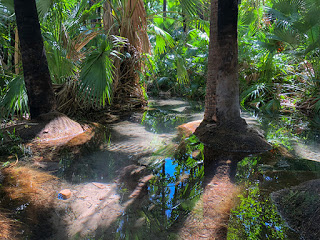
Just a short walk with a couple of boardwalk water crossings and we’re surrounded by palms, rocks and orange cliffs within a narrow gorge. It’s spectacular. This is the kind of scenery we were hoping to see and Western Australia has excelled. Some have likened this gorge to a place you would expect to see dinosaurs roaming about, they are not wrong.
Running through the gorge is pure, clear water. But this water sits between 28 and 32C. Rising from deep within the earth the water brings warmth and minerals along with it providing nutrients to the rich flora that flourishes here. Much as I am apposed to using beautiful places like this to swim, at least the numbers are controlled and it isn’t a National Park.
Thermal Pools
Lunch Time
The day was still not over and Emma was driving us back to our camp for our lunch of grilled barramundi and beef, included in the full day’s tour. We were joined by a very tame, and probably very well rehearsed, visit by a Kookaburra happy to pose for photographs.
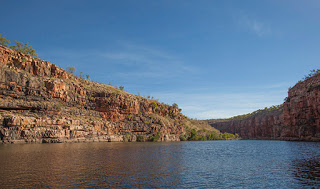
The afternoon adventure was another drive but this time over to the Chamberlain River. Now we were starting to see the true extent of this property with countless group campgrounds leading from the dirt road into the bush. Our driver and guide, Silvia, took us to the jetty where we boarded our cruise boat and set-off down the river.
Before long we had spotted a rock wallaby well disguised on a ledge in the cliff and then a freshwater crocodile basking in the sun. There was plenty of life in the water too, as we later found out, and not what you would expect.
Attack of the Archers
At the midway point of the cruise where are path is blocked by rocks pushed downstream during the wet season, we stopped and were quickly surrounded by many species of fish. Large catfish, seven spotted archer fish and barramundi hiding somewhere just out of sight. Vinnie, our skipper, handed out fish food and suggested holding it over the water. Was he expecting the fish to jump out of the water or was he getting us to lose a limb to a crocodile?
Chamberlain River
All of a sudden spouts of water were shooting out of the water and all over us. These were archer fish and they had learnt to shoot a jet of water at insects hanging on to tree branches and knock them in to the water. They have an amazingly accurate aim even allowing for the diffraction of vision through water. It had everyone on the boat laughing as we continued to get wet, though that may have been helped by the sparkling wine!
As we made our way back our eyes were searching for more creatures and a bottle of bubbly was on offer for the first find – or $5 donation to the Royal Flying Doctor if it was the same animal we had spotted before.
Another great tour and a great introduction to the Kimberley. Again highly recommended. More details available atwww.elquestro.com.au
We bought our Land Rover Discovery 5 for its ability to go off-road and to tow our Jayco Silverline Outback caravan. Today was the first time we put the combination to test on the gravel access road that leads from the notorious Gibb River Road to El Questro where we’re staying for the next three nights.
Now for those not familiar with the Kimberley and northern WA in general, this region of the country is often referred to as Australia’s last great wilderness and it has the remoteness and dirt roads to prove it. Our drive into El Questro was supposed to be on a relatively good road but here ‘good’ should be used only as a comparison to very bad roads. Severely rutted enough to shake fillings loose and scramble eggs, the road contained just as many loose rocks as a landslide.
Where’s the Grader?
According to a sign at the start of the 14KM track the road was in the process of being graded to flatten out the ruts. I can only assume the grader was taking a holiday elsewhere. But this car and caravan were designed to handle this kind of torture even if we, with our ageing backs, were not. Then added in to the mix were the inconsiderate drivers going in the opposite direction as fast as they could creating clouds of dust that forced us to slow even further until we were able to see again. The challenge of cornering on a loose surface with a large vehicle in tow was soon mastered and then came the first of two water crossings.
Water Crossings
Some person we had met earlier had advised us that the crossings were dry. Clearly they had been nowhere near here. It hadn’t rained for months but there was certainly a lot of water and loose, hidden boulders in the first crossing. Still, no problem, we have a high clearance caravan with independent suspension and a 4WD car that can handle a wading depth of 900mm. So, into 4-wheel drive, high clearance and auto traction control and off we went with ease until halfway across… and we stopped. For some reason the auto mode decided we were going downhill and switched to hill decent control. Never a good think to stop in water, I quickly switched to manual control, rock and gravel mode and off we went again for the remainder of the crossing and up the ramp back onto dry land.
More rough road, more inconsiderate drivers and then the final water crossing. This one three times longer and looking twice as deep. In we went, still in the same 4WD mode and an oncoming driver decided he was going first. Eventually he realised he was in the wrong and backed-up, something we could not have done and the crossing was wide enough only for one vehicle. With a small wave in front and to the side of us and the sound of rushing water coming up the doors, we sailed through without issue and up the bank onto the final stretch of road into El Questro and the Black Cockatoo Camp Ground.
The car and caravan had proven their worth easily handling the challenging conditions even if they were both now coated in a layer of grey dust and about to get a covering of red dust at the camp.
El Questro is an enormous property covering 1-million acres and home to many outstanding natural features, gorges, rivers, fauna and flora – the very reason for our visit and the effort it took to get here.
El Questro Sunset
Tonight is pizza night at the outdoor camp restaurant and after a beer or two, the rest of the day is set aside to relax and rest our aching joints ready for the adventures that lay ahead.







 Discovery Down Under