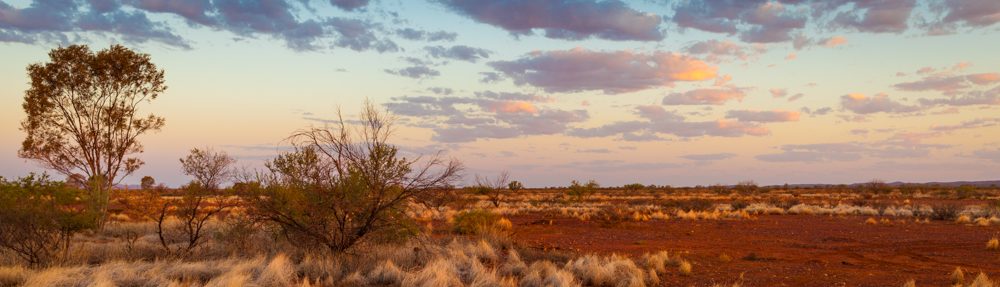
After not having a lot to say about Derby, Broome is a complete contrast – alive, thriving and comfortably welcoming.
We are staying at the RAC Cable Beach Holiday Park, one of two caravan parks with the same Cable Beach name. Ours is right across the road from the sand dunes leading to the enormous beach that seems to stretch in either direction to the distant horizon.
Broome is divided into distinct regions of industrial, local trades and the main shopping and cafe area – all divided right down the middle by the International airport. It’s very common to be sitting enjoying a peaceful coffee as a seaplane, helicopter or jet airliner swoops just a hundred feet overhead. But, surprisingly, it’s not noisy. The aircraft traverse so quickly from the sea approach that you only hear and see just a brief passage. The only slight annoyance is the larger helicopters that ferry the oil rig workers to their platform out at sea early in the morning.
Broome was built to service the pearl industry but not quite as expected, at least by us. For many years the mother of pearl from the oyster shell was the chief export used for jewellery and decoration but mostly for buttons. The pearl itself was extremely rare with just one in ten thousand oysters containing the gem and naturally grown they were seldom the smooth round pearl of favour. Even so Broome was at the heart of the industry with a large Chinese workforce, which is evidenced today by China Town – Broome’s shopping and cafe centre, which still has that oriental feel.
Broome’s reliance on mother of pearl was hit by a downturn in the market as other forms of button materials such as plastics, took hold. But as we will later explain, the pearl industry was about to change thanks to the Japanese, the very same country that attacked Broome repeatedly during the Second World War.
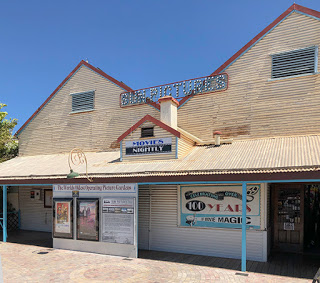
The town is home to the Sun Pictures cinema first opened in 1916 and the oldest, still operating, open air cinema in the world. Situated on Carnarvon Street it continues its long tradition of deckchair seating. It’s worth a browse even if you don’t have a spare evening to watch one of the latest films. Just remember to take a light jacket or sweatshirt as it gets cool at night during the dry season… or an umbrella and waterproofs during the Wet!
Also on Carnarvon Street is Broome Gallery and the studio of James Down. Here you will see some excellent, and highly amusing, acrylic paintings of the region and its wildlife. Bright bold colours is exactly what this part of the Kimberley is known for and equally reflected in James’ paintings.
In need of a coffee
If you are looking for a great location and a good eat then we heartily recommend the Dragonfly Cafe on Carnarvon Street. You can’t miss it’s corner location – it’s always busy. Great meals, cakes and good coffee too.
Markets
Broome hosts regular markets and the best by far is the Saturday market at the Old Court House, which also happened to be the terminal point for the first international undersea cable from Australia to Indonesia providing telegraphic communication with the rest of the world.
The market has plenty to see in the form of artworks but also coffee, tasty hot and cold food, fresh fruit and vegetables stalls.
One artist in particular stands out and that is Tom Montgomery and his stunning watercolour paintings of local birds and reptiles. The detail and life he puts into each painting is truly remarkable. So impressed were we that we bought two of his images to remind us of what the Kimberley has to offer.
Cable Beach
Broome’s Cable Beach stretches as far as the eye can see and is a highly popular spot to sit and watch the sun set over the Indian Ocean, walk or collect shells. In the early evening 4×4’s make their way along the beach to find the ideal spot for happy hour as the sun sinks below the horizon. But here you will also find another form of locomotion and a more natural one at that – camels.
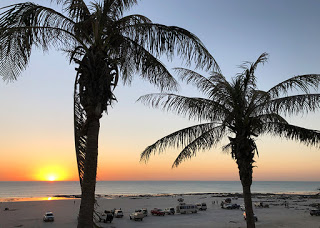
Each day a team of camels takes tourists on a ride up and down the beach and with palm trees dotted along the sand dunes you could easily mistake this place for some distant Arabian desert. Australia, surprisingly, has the largest herd of camels in the world. There are so many that a control programme has been introduced to limit the numbers in an effort to reduce the damage to farmland. Some are captured and exported to Arabian countries, though their preference for what are known as ‘pretty’ ones is a little, er… puzzling.

Camels however are not a native to this country. They were brought into Australia from India, Arabia and Afghanistan and led by the Afghan camel teams who helped explore and open up the harsh territory of central Australia and transport goods and equipment to the teams building the overland telegraph line from Adelaide to Broome. Once the work was complete the camels were let loose and in the wild they just did what came naturally. Now their population is estimated at over a million and doubling every 8-9 years.
Prior to the camels, and by a long, long way – around 130-million years ago – were dinosaurs when this region formed part of an ancient river estuary. Though hard to identify, Sauropod and Theropod tracks can be found in the Cable Beach sandstone slabs exposed at low tide. An identification and location chart is available from the Broome Information Centre.
Sand Trees
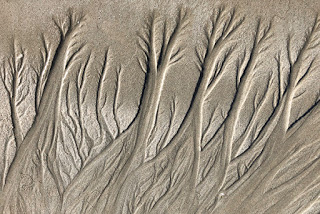
As the tide goes out, unusual patterns appear on the beach – some caused by sand crabs but a more unusual one caused by channeling water as it drains down the shallow beach. The patterns resemble the Boab trees common in Western Australia.
Gantheaume Point
Further south is Gantheaume Point and it’s steel towered lighthouse. Just a short stroll along the pathway will have you looking at a view that resembles the surface of planet Mars. The iron rich sandstone displays all the shades from deep red through yellow to orange. Giant slabs of rock mix with volcanic vents stained with sulphur and all backed by the turquoise Indian ocean. As a photographer you could spend hours here especially leading up to sunset.

For those more interested in fauna than rocks and boulders, take a close look at the tower and you may get to see nesting Ospreys. And looking out to the ocean keep an eye out for whales and dolphins.
There is plenty to see and do in and around Broome and if you’re on a Big Lap like us it makes a great resting point before heading out into the wilderness of the Pilbara.
For more information, the staff of the Broome Tourist Information Centre opposite Woolworth’s are very helpful. Coffee available most days too!
 Discovery Down Under