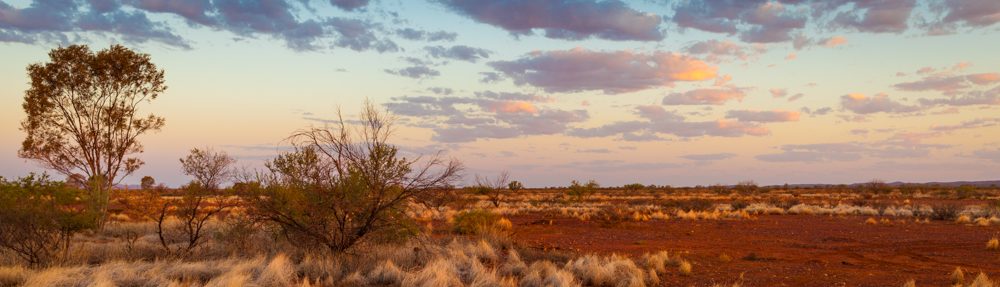
A very early start today to meet with our tour at 6.15am but at least we get to see a WA sunrise as compensation. We had been warned that we were in for a rough ride along the rutted gravel road to our destination and it was, very rough. But getting to see special places like today’s in Australia is rarely easy, or comfortable, but worth it.

Today we are heading out to Purnululu National Park, a World Heritage Site, previously, and more popularly, known as the Bungle Bungles. Little known or explored by Europeans until an ABC TV programme filmed in the area in 1983, when public and scientific curiosity was aroused. What had created these spectacular black and orange stripped, beehive-shaped rock domes?
The Bungle Bungle Range has been on our must visit list for many years and today, finally, we were not only going to see them but also walk among them. And more…
Rough Ride
Our 4WD bus didn’t look in the best shape, but then what would after 450,000KM on dirt roads. It still had life in it and apparently coping better with the Bungles than the new bus that was shedding nuts, bolts and passenger seats. But an hour of bone-jarring ruts, bumps and floodways, past ghost gums, mounds of spinifex, dry creeks, feeding wallabies and moonscapes, got us to the Purnululu Visitor Centre. We still had 30-minutes of rough road ahead of us to reach our destination but everyone was ready for a break and a chance to stretch and put joints and false teeth back in place.
The Domes
There are some enormous escarpments along the route, moonscape-like hills and green valleys full of ghost gums, not what we had expected to see from all the published photographs, but these were just a teaser to what we finally started sighting – the characteristic stripped domes of the Bungle Bungles. And it wasn’t long before we were enjoying our morning tea break stood right in front of these amazing, other worldly domes.
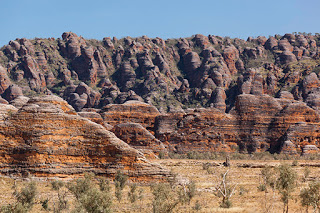
What, on first appearance looks to be different layers of rock, the domes are actually comprised entirely of almost white sandstone. The orange bands are layers where water from the wet season has seeped to the surface taking iron along with it and rusting where it is exposed to oxygen. This is the same process that causes the classic red earth and rock of much of the north and west of Australia. The black bands are also the result of water seepage but have a higher moisture content allowing Cyanobacteria to grow on the surface. These are the same single cell life forms that were known to exist 3.5-billion years ago, one of the earliest known forms of life on this planet.
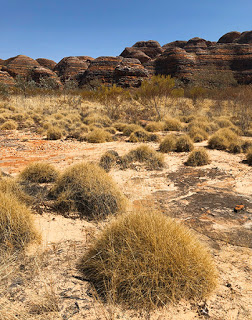
You have to ask where this sandstone came from in the first place, after all sandstone was once just loose sand formed by the sea, glaciers or rivers. A clue is visible in narrow bands of the rock walls. In this case pebbles of an ancient river are embedded in the sandstone showing this area has had fast flowing water for millions of years. But in turn those pebbles were at one time themselves, chunks of rock that tumbled from ancient cliffs into flowing water. Research suggests the rock that forms the Bungles is between 350 and 400-million years old and their current form has been created over the past 20-million years.
Our first walk took us around many of the sandstone domes along a dry creek for a close-up view where our guide, Steve, explained the process that created them and the related human history. They look delicate, and in places they are but the Cyanobacteria is helping bond the sandstone surface slowing its erosion. Needless to say we were all looking through our viewfinders for the best place to take a photograph as we continued our walk.

The Aborigines have known of these features for tens of thousands of years and many areas are held sacred by them but the first Europeans that passed through on cattle droves thought them nothing remarkable. By contrast, in 2003, Purnululu was added to the UNESCO World Heritage List joining such elite company as the Grand Canyon, Yellowstone and Yosemite National Parks in America, the Dolomites and Mount Etna of Italy and, of course, Australia’s eleven other listed sites including the Great Barrier Reef.
Cathedral Gorge
Part way along our walk the path divides leading to Cathedral Gorge, a place of outstanding proportions. Walking beside a deep but dry riverbed cut by rushing water, we followed a narrowing gorge with orange sandstone walls rising over 200-metres above us and climbing several sets of steel steps before the enormous scale of Cathedral Gorge was revealed.

It is hard to convey the scale of this place from a photograph – you really need to be standing here yourself to appreciate just how big this water cut gorge is.
You will certainly have seen it on TV or any Qantas flight where the heart tugging ‘I still call Australia home’ song is played from the gorge along with the entire Sydney Symphony Orchestra.
Echidna Chasm
The day was still young and following lunch we were off again, this time to the north and another hour on the gravel road. Our next destination is Echidna Chasm and what a remarkable place it is and absolutely worth the discomfort.
The path is a little tough on the ankles as it clambers over large river rocks and boulders beneath towering cliffs lined with Livistona trees. However, these cliffs were entirely different from the domes we had left behind. The entire area is comprised of conglomerate, a mixture of different size pebbles and boulders solidified in place by sandstone. Where exposed to oxygen it looks much like orange-coloured concrete and is almost as hard.
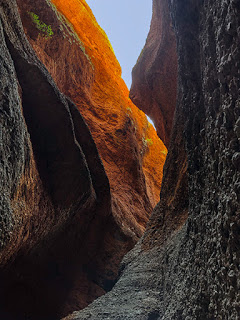
The chasm quickly narrows and darkens with slits of light from above giving the upper reaches a warm glow. Several large chunks of rock have fallen but remain precariously wedged between the chasm walls and further in, just as it looks as though the way is blocked by huge rock falls, you can weave your way around them, up steps and finally arrive in a round amphitheater with unusually high humidity.
The return walk is just as impressive as you work your way closer to daylight and the dry heat of the sun. We hadn’t heard of this chasm before but so glad we got to see it.
Lookout!!
As we headed back towards camp on another long, rough drive, Steve had a treat for us. We stopped at Steve’s favourite viewpoint and what a impressive place it was with a 360-degree view across a valley with spear and spinifex grasses, ghost gums and orange cliffs glowing in the setting sun. The steep but short walk to the top was worth every step.

Dinner
One last treat was waiting for us as we got back to camp. Included with the full-day tour was dinner, which tonight was three large pieces of eye fillet, cauliflower and broccoli bake, sautéed potatoes and two salads with apple pie and ice cream to follow along with the great company of our fellow tour group.
Of all the tours we have done on our trip so far, this one is right up there with the best. You do need to be quite fit, wear suitable enclosed walking shoes and can handle the rough drive and uneven paths, but it is worth every ache you’ll have the following day.
More details at Bungle Bungle Day Tour
 Discovery Down Under