Being so close to Asia made Darwin the target of the Japanese during the Second World War. The largest single attack on Australia from enemy raiders, more aircraft and more bombs were dropped on Darwin than the surprise Japanese attack on Pearl Harbour. In just one day on February 19th 1942, over 110-tonnes of bombs hammered the city, ships and airbases in two raids in an attempt to prevent Australia’s wartime allies using the region in support of the Pacific War. The raid killed 236, wounded nearly 400, destroyed 30-aircraft and sunk 11-ships at the cost of just 2-Japanese pilots.
The Darwin Aviation Museum has many items from the attack on display including Japanese aircraft wreckage and some rare amateur footage of the attack.

By far the most impressive item on display, by a very long way, is the enormous US Boeing B-52 Bomber around which the museum is built. And I mean around. The wingtips only just clear the museum’s hangar walls and the tail almost touching the pitched roof. This is one enormous eight-engined aircraft.
With a wingspan of 56-metres it dwarfs every other aircraft on display including the huge General Dynamics F-111 supersonic bomber relegated to a corner of the hangar and a 1960’s era Sabre fighter, which sits under the B-52’s tail.
First flown in 1952 the B-52 Stratofortress was the American bomber designed to deliver nuclear payloads during the Cold War as part of SAC – the Strategic Air Command on 24-hour alert with aircraft constantly in the air.
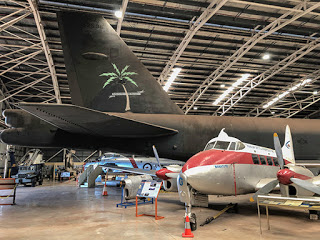
This particular aircraft was recently retired and presented to the City of Darwin as a gift. The B-52 is still in service at bases around the world including Guam and is a regular visitor to Darwin. We were advised one was shortly to takeoff from the airfield behind the museum so we were keeping an ear out for it, not that you were likely to miss the high-pitched whining from its engines on take-off nor the trail of smoke it leaves in its wake.

No Barriers
One of the great things about this museum is the lack of barriers. You are free to touch the aircraft, take photographs anywhere and on regular occasions, climb into the cockpits. The F-111 is the only one with a chain fence but that’s more about public safety.
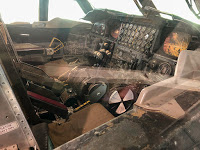
Sadly the cockpits for all the aircraft including the F-111 were closed today but you could still climb up and peer inside at the tiny space the pilots had to fly in. And in complete contrast the B-52’s bomb bay doors were open to view and big enough to swallow two coaches with room to spare.
The museum houses many early piston and jet engines including the famous Rolls Royce Merlin Engine used in the Spitfire, Mosquito and nearly all the Lancaster Bombers as well as the Rolls Royce Derwent jet engine based on Sir Frank Whittle’s original design, which powered Australia’s first jet powered aircraft – the Gloster Meteor from 1946 to 1963.
There are many more aircraft both large and small to view, helicopters, microlights and a bone yard of sorry looking aircraft outdoors. It’s an interesting place with some unique aircraft and a wealth of information on the Japanese raids on Darwin.
We missed the B-52 take-off but a few days later I saw another B-52 climbing slowly over Darwin through my rearview mirror. Quite a sight.
For more information check: www.darwinaviationmuseum.com.au
 Discovery Down Under