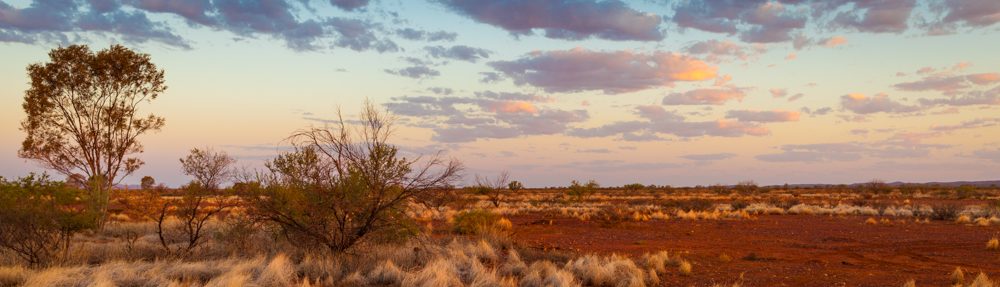
Today we’re heading to the wetlands of the Yellow Water Billabong and South Alligator River in search of crocodiles and wading birds. Now it’s a curious name Alligator River, and I have used the correct name, when there are no alligators. It could have been named pretty much anything else, Crocodile River for one but that would have been just too obvious. One possible explanation for this curiosity was an early settler to the region who arrived here from Florida. Another says his boat was called the Alligator. Either way it’s a pretty dumb name.
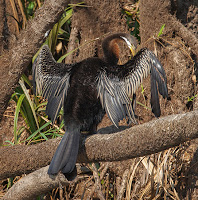
Our cruise started with an excellent guide, Martin, who mixed a good sense of humour with a lot of knowledge and it was very clear he was passionate about this double listed World Heritage site. And almost immediately we were spotting wildlife – catfish swimming past us and Batman spreading his wings. Well, Martin told us it was Batman but I’m pretty confident it was an Australasian Darter spreading its wings to dry in the sun.
Just around the bend of the river and there was Max, a huge male estuarine crocodile basking in the sun getting his blood temperature up ready for another relaxing day. He was so used to cruise boats that we nudged the boat right beside him. He didn’t seem to care. Either he was still too cold to make the effort or he was thinking, ‘just a little closer, come on, just a little more…’

The cruise continued briefly and then more wildlife – an intermediate egret (great name by the way) magpie geese, another crocodile and another, hundreds of plumed whistling-ducks, a great-billed heron, another egret, a royal spoonbill. And trees too – freshwater mangroves, paperbark and pandanus and a few thousand royal lotus flowers. This place was teaming with life, and that was just above the waterline.
Each time Martin began to explain or describe something there was another creature to see. And everywhere we looked was green, lush and healthy. We were only a few months past the wet season and water levels were still dropping but it was hard to imagine this area ever being under a further two-metres of water and year after year at that. Few trees would ever survive such a soaking but the paperbark tree is one, a true survivor and the pandanus too. It’s no surprise that these are the dominant large trees in the wetlands.

The wetlands are dominated by grasses and they have a clever way of surviving the deluge of the wet season – they float! What looks like land you could walk on is anything but, step on it and you’ll be looking at fish, long-necked turtles and more likely something with rather large teeth.
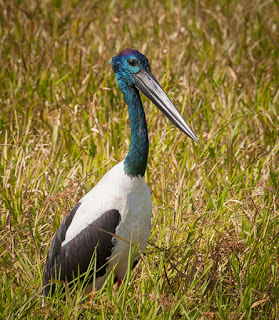
More crocodiles basking in the sun and then something a little special, one bird we had been hoping to see – a Jabiru. A huge bird with an enormous black bill. Sadly there’s a problem here. The Jabiru is also a South American bird and the powers to be don’t like two different birds having the same name, so the Australian Jabiru, the one the Kakadu township was named after, has been demoted from the cool names category and is now just known as a black-billed stork.
In the distance was a water buffalo, not a popular animal here any longer – one we saw had recently been shot by Park Rangers and is now being closely guarded by yet another crocodile. Along the edge of the river, clambering over the lily leaves, was a tiny water bird, oblivious to crocodiles close by, with enormous feet, comically large feet, known as a comb-crested jacana. Now that’s a name to be proud of.
And just watching us on the branch of a dead tree was Australia’s second largest bird of prey – the white bellied sea-eagle. A magnificent bird with a massive 2.2-metre wingspan.
Turning around and heading back to the jetty and we were stopping again. There was another Jabiru, a male this time, more crocodiles, more intermediate egrets, lilies, jacanas, whistling kites and magpie geese flying overhead.

I wasn’t too sure what we would get to see on this trip. There is less bird life than during the wet season but there was more than enough variety, more than we’d seen before in one place, more than we’ll likely see again for a long time.
There was just one large bird that we were hoping to see that we missed – the Brolga. Maybe next time we need to visit during the wet season.
Another great trip and an excellent guide, boat captain and coach driver too. Thank you Martin.
Yellow Water Cruises are run daily by Kakadu Tourism from the Cooinda Lodge. Bookings are highly recommended.
 Discovery Down Under