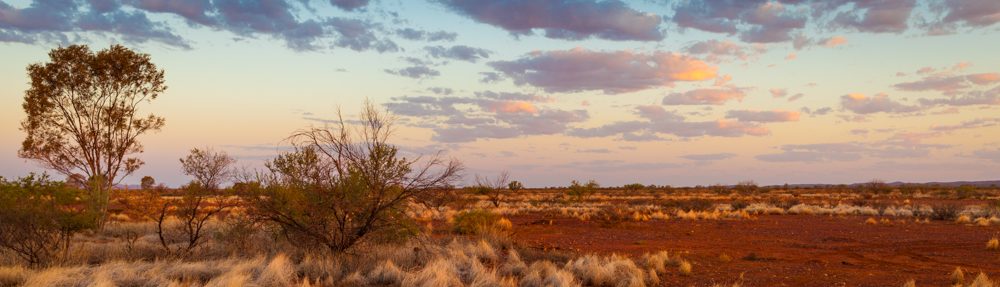
Despite all the TV programmes and photographs of Kakadu, I never expected to see so many trees. Not particularly big ones but there are reasons for that and they’re largely to do with bad land management – depending on your point of view. And despite the dry season I hadn’t expected everywhere to be so dry and with such low humidity, which is a bit of a blessing.
Our main adventure is actually just over the Kakadu National Park border. We’re heading into Arnhemland, a magical place rich in both culture and wildlife. We’re doing the Arnhem Lander Cultural and Heritage 4WD Tour with Kakadu Cultural Tours.
River Crossing
The adventure starts as we reach the Border Store on the edge of Kakadu National Park. Here is our first taste of a river crossing on the East Alligator River and we’re certainly at the right time of year in the right type of vehicle. The crossing is a man made weir named after Cahill, one of the early settlers who introduced water buffalo, and shows signs of those a little more confident of their skills and vehicles than they should have been. We saw two large 4WD cars just breaking the surface of the water and there were surely more never to be recovered.
Fortunately our vehicle was a large 4WD truck and the shallow water wasn’t going to claim this one as a victim. Beyond the crossing and we were in a restricted zone, Arnhem Land, an aboriginal reserve and National Park. Almost immediately we were in a different landscape and on a corrugated dirt road certain to dislodge any loose fillings. Trevor, our guide and driver, knew this road well and adjusted the speed to minimise the vibration.

The landscape varied from open plains of grasses to wooded groves with the type of tree changing as we traveled further. In the distance was the Arnhemland Escarpment, the oldest rock in Australia, so old it contains no forms of fossil of any species including bacteria. At 1,500-million years old it is thought to have formed long before life took hold on this planet. And being comprised of sandstone, it had been a mountain tens of millions of years prior to that before eroding and settling as sand in an estuary.
White man doesn’t listen
During this time Trevor described the modern history of the region and the poor management of the land after the white man took over and introduced water buffalo. Partly for food but mainly for export, the water buffalo trampled the grassland, knocked down small trees and saplings and encouraged weed growth.
Also introduced was uranium mining in an area known by the local mob as ‘Sickness Land’. They knew from their history that the areas starting to be mined made people ill. They may not have known about radiation from the uranium or the high levels of lead and mercury but they knew it was an area to be avoided. The mines and the buffalo grazing had a devastating effect on the aboriginal people, the animals they relied on for food who’s environment was being changed and the land they had lived on for countless generations, land they cared for and knew how to manage.
Around the time of the Land Rights campaigns, a local elder complained that the land was dying and discussions with the government ultimately led to a compromise – the government would create a National Park to protect the land but only if the aboriginal people agreed to allowing mining to continue with no more than three active mines at any one time. The compromise was agreed but that was the start of more trouble.
White man doesn’t listen… again
It has been known by the aboriginal people that burning the land in a controlled way benefited their food resources but also kept the growth of trees and grasses under control. Burning the spear grass created fresh new growth within days, which attracted wildlife and ultimately food for the people. They knew when to burn and what to burn and created patchwork burns to help prevent wildfires from lightening strikes causing large, hot fires that were too severe for trees to survive and worse, the hot fires also destroyed the seeds of the trees resulting in areas of no tree growth.

Ignoring the years of knowledge of the local people, the National Parks tried to protect the land rather than manage it. Lack of burns led to dense areas of saplings and combustible leaf litter and dry grasses led to hot fires, which killed not only the saplings but also the larger trees and seeds. Eventually things began to improve when the National Parks began to employ local people and the need for controlled burns was more understood. With the exception of some political parties, the need for controlled burns are well known and are now common practice throughout the country.
Trevor spoke about the paperbark tree as we drove through an area of rich grass and standing water. The tree has some remarkable properties. The bark is both waterproof and fireproof and the sap contains a natural antiseptic. Well known to us as the Tea Tree, the aboriginal people use the bark to make canoes, wrap food before baking in the ground, as a painting surface, for roofing material and as a soft blanket for babies. Being fireproof they can also light fires in their canoes for heating and cooking while out fishing.
Crocodile talk
Our first stop was beside a river where Trevor explained crocodile behaviour and safety. Knowing how crocodiles behave is a major key in being aware when near rivers or where crocodiles may inhabit. And just beside where we stood was evidence a crocodile had been here with telltale tracks in the sand – a male. Male crocodiles climb out of the water and turnaround facing the river prepared for any competing male. They probably get the nicest view too.

Just a short stroll and we were in open wetland with views over to the ancient Arnhem Land escarpment and water birds, lots of them. Magpie geese, Jabiru, spoonbills… all among brilliant green grasses and flowering lilies. This was the scenery I was expecting. It was beautiful. Not to feel too comfortable in our surroundings, Trevor cautioned us about some of the other wildlife that calls this place home. Australia is well known for its venomous snakes and Arnhem Land and Kakadu are home to most of them. And another less than savoury but entirely man made issue is the Cane Toad, described earlier when we were in Bundaberg. Hundreds of tiny cane toads were just making their way from a small billabong near where we had parked. Fortunately these poisonous little creatures would soon be food for larger animals, including some snakes that have built up a resistance to their toxins.
Our next stop was at the Injalak Arts and Crafts Centre in Oenpelli. Like many aboriginal settlements it was a little rough around the edges with dogs roaming around. But the people were friendly as ever with big smiles. The gallery here is a major source of income and for once the artists weren’t being exploited. Each piece of art is priced in agreement with the artist who receives 97% of the sale price with the remaining 3% going towards gallery and administration costs. Unlike the overpriced artwork sold in the big cities, we were able to purchase at the wholesale price, which gave a very clear indication of the enormous markup galleries charge.

We were guided around by Tony and introduced to the artists. It was quite an honour to see the skilled work in action and to be able to talk with the artists about their work and the meaning behind the style of painting. One favourite of ours, Benson, so named after the cigarettes he used to smoke, was extremely good at showing the technique he used and the steady strokes he had developed over 30-years. The painting he was currently working on was likely to take him 3-weeks from start to finish. Looking at the detail and delicate brush strokes it was not hard to understand why.
Examples of some amazing screen printed art, paintings on bark as well as weaving were also there to be seen as the artists worked on them. But then we stepped into the display gallery. It was like walking into another world, a gallery and shop to equal those in any city. The place was full of the work done by the local artists and at reasonable prices.

We could have spent hours here admiring every piece but our eyes settled on one in particular of a Barramundi and unusual in having a grey background rather than the traditional red ochre. It was painted by local artist Craig and we were advised by the staff that he was somewhere around the gallery and would happily have his photograph taken with the painting. He was too. He took us to a spot with the wetlands and escarpment in the background and produced a big, proud smile for us. We were both very grateful to him and expressed our thanks and admiration for his work. We’ll never forget this experience and have vowed to send him a photograph when we have it mounted and displayed at home.
Lunch followed right next to the Arnhem Land escarpment but a big surprise was in store for us. Part of the tour takes you to see rock art but not like you will see behind protective bars or Perspex in National Parks. Here we were going to see a very special site. Trevor had assessed the fitment level of our group and believed we were up to the challenge of clambering up the escarpment to view some rarely shown rock paintings. This was something we both greatly wanted to see on our trip around Australia and were blown away with what we saw.
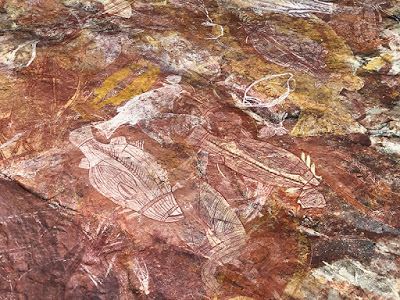
It was quite a scramble but well worth the effort for the amazing view it provides across the wetlands and the escarpment into the distance. But just behind us beneath and along a rock overhang is some incredible ancient rock art. At least 20,000-years old, many of the paintings looked as if painted recently in amazing detail. Several generations of style were clearly visible including the X-ray style that this region is known for. Trevor explained how the images were created and how they are able to date some of them based upon known animals that have been extinct for thousands of years. Sharks and squid confirm the area once was a sea, kangaroos that no longer live here, barramundi, eels, snakes, echidna, wild pigs and, of course, crocodiles can all be seen here among many of the traditional Dream Time images.
And then it got better with more and older paintings and again at an area few get to see. Here, in intricate detail, were story lines with mother figures, serpents, yam-headed people and many more all described with so much knowledge by Trevor.
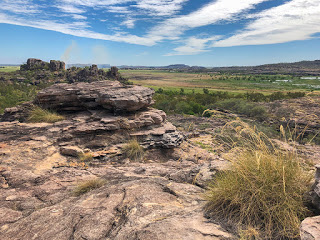
The scramble back down to the truck was just as much fun as the climb but always looking around for anything hiding under the rocks and ledges, anything that might be startled and tempted to bite. We carry a snake and spider bite kit with us when walking in the bush but, of course, being aware of your surroundings and avoiding bites in the first place is always the better option and far less painful.
The rock art was the highlight of today and it is a tour that we cannot recommend highly enough.
More information on the tour can be found at www.kakaduculturaltours.com.au
 Discovery Down Under