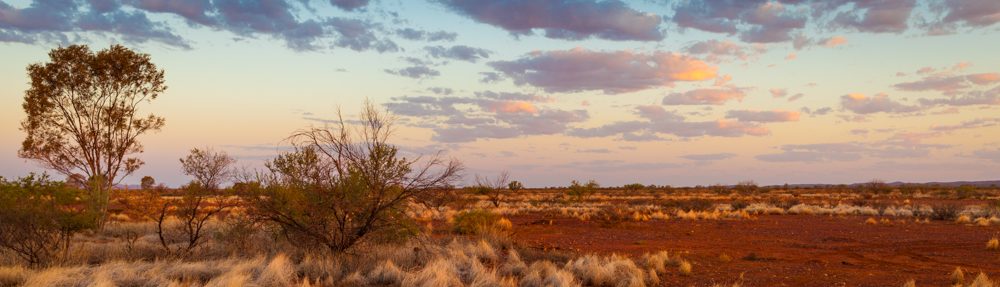
At last, we’re staying at one location for more than an overnight stop. We have arrived at Mataranka, a small township on the edge of Elsey National Park.
Our camp for the next four nights is the Little Roper Stock Camp, a rustic, dusty campsite but with plenty of shade from the heat of the sun. It’s a friendly place with an evening campfire and fresh bread baked daily to order by Des. There’s nothing like a fresh, crispy loaf and the smell of baked bread in your caravan in the morning… other than a freshly brewed coffee of course!
Johnny Cakes are also available at 8am by the campfire. These date back to the 16th century in the UK but also popular as Journey Cakes during the American Civil War. They are simply flour, salt and water mixed and formed into a pancake shape and cooked in shallow oil.
Bush Walks
We’re here to do some bush walking and also for a dip in the hot springs, which this National Park is known for.

Our first short stroll was around the Botanic Walk, which starts from the roadside carpark and forms a 1.5KM loop. Many of the trees and shrubs are identified with their scientific name as well as the aboriginal name and what they used them for. Leaves crushed to make soap, lemon scented leaves for cooking with fish, sandpaper leaves for smoothing spears and tree trunks carved with stone tools to create canoes. Also many paperbark trees whose bark peeled, dampened and used to wrap fish before placing them over hot ashes. Trees even used to identify the time of year – in this case flowers bloom just as crocodiles begin to lay their eggs, a local delicacy.
Be Croc Wise
Our second walk for today, at 4-Mile, leads along a gravel track to the river and a boat ramp. This was our first view of the Roper River. Now around here you may be tempted to jump in to cool-off on a hot day. The water is certainly inviting, fresh and cool with some beautiful trees lining the river banks. There are, however, a few hazardous things in the river – submerged trees for one and one or two crocodiles – both Freshwater and Salties. The freshwater crocodiles keep to themselves but the saltwater variety, well, best to leave them well alone. As such, swimming and canoeing are no longer allowed in the rivers. Needless to say we didn’t get too close to the water – we still have many places to visit on our trip where limbs are quite useful.

Our second walk for today, at 4-Mile, leads along a gravel track to the river and a boat ramp. This was our first view of the Roper River. Now around here you may be tempted to jump in to cool-off on a hot day. The water is certainly inviting, fresh and cool with some beautiful trees lining the river banks. There are, however, a few hazardous things in the river – submerged trees for one and one or two crocodiles – both Freshwater and Salties. The freshwater crocodiles keep to themselves but the saltwater variety, well, best to leave them well alone. As such, swimming and canoeing are no longer allowed in the rivers. Needless to say we didn’t get too close to the water – we still have many places to visit on our trip where limbs are quite useful.
Mataranka Falls

The following day we set-off for a longer walk, which forms part of the 16KM trek alongside the Roper River. Starting at 12-Mile Yards, an old cattle stock pen, our walk started off badly through what can only be described as sand. The track is bone dry and comprises a mix of gravel, very soft sand, dust and a few patches of rocky outcrop. It’s hard going where the sand has settled into long hollows but eases further into the walk. A few glimpses of the river between cabbage palms eventually brings you to an opening with a good view along the river, which has formed along a natural fault line between limestone and the deep red sandstone.
Each kilometre is a marker and well signed way-posts help keep you on the right track. Both sides of the pathway have many trees and shrubs providing some shade but the most striking thing is the number of large termite mounds, some reaching up to two metres high. These industrious creatures are vital in this environment. The termites eat grasses and hollow out trees as well as lifting many types of mineral to the surface. Once the colony dies the minerals are slowly released as a fertiliser preventing the ground from being leached each year during the wet season. The termites are also a source of food for birds, reptiles and frogs. The hollowed out trees serve as nests for parrots and provide the base material for the aboriginal didgeridoo. Not quite as destructive as we are led to believe.

Every so often I noticed what appeared to be clumps of white fluff along the path. We soon found the source – several wild cotton plants. We have seen some cotton plants growing in Queensland but this was the first in the wild.
After a few creek crossings where aluminium bridges had been placed, the path opened out into a sparsely vegetated rocky outcrop in the full heat of the sun. But eventually, after scrambling over limestone rocks and tree roots we could hear the waterfalls but we couldn’t see them.
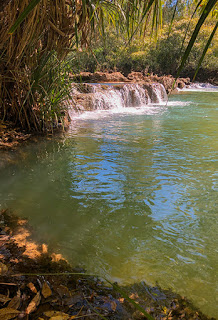
We weren’t expecting too much having seen photographs previously but we were left wondering where the photos had been taken from. All along the riverbank, where the falls were, trees and long grasses obscured the view. Only a few spots gave a glimpse and each of these were right by the water in low lying areas – ideal for crocodile access.
For the moment we carried on to a small campsite for lunch where we met a lovely lady from Tasmania. She had already tried to find a better viewpoint from the high ground and saved us the effort.
On our return leg I built up the courage to get closer to the water and quickly took a few photographs while keeping a close eye on anything that may be hungry. It was now hotter even hotter and our return trek on the 8.4KM walk was interrupted only by a few shady spots and a drink of water. I would hate to think how hot and humid it would be here during the summer. And how wet too, much of the area shows signs of flood where the wildlife is more likely to wander further afield. A great walk but there is better to come.
Bitter Springs
Mataranka is rightly famous for its thermal springs. Water filtered by the limestone hills of the Barkly Tablelands and bedrock works its way to the surface carrying with it heat and a rich supply of minerals, especially calcium. Mataranka has two popular springs, one at Mataranka Homestead and the other, far more natural and our choice, at Bitter Springs just a few kilometres from our campsite.

The water is a very pleasant 33C, extremely clear and free flowing. From a carpark a short concrete path leads to the start of the defined swimming area. From here a ladder drops you into the spring and you simply relax and let the slow current take you along several hundred metres of beautiful forest to a ladder and bridge, which marks the return path to the start. Although busy on our visit, the current keeps people moving along so it doesn’t become crowded. Sadly I appear to have started with a chest infection so only Catherine got to enjoy a swim.
Today marks our third month on the road and it’s hard to imagine returning to a more normal life in suburbia with traffic and road noise.
Tomorrow we set-off again a little further north and another Northern Territory adventure, this time in Katherine.
 Discovery Down Under