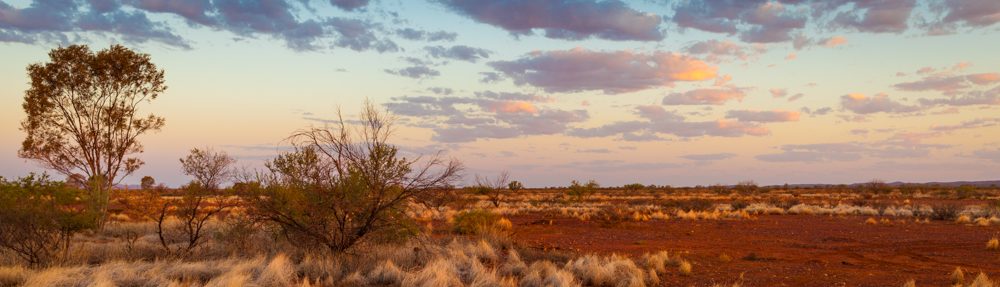
Today we’re heading for the high ground – something not so easy to do on the endless, flat plains surrounding Winton. But the exception here is a range of mesas that are composed of harder rock than the surrounding land leaving a chain of flat-topped hills almost 100-metres above the plains. We’re in Central West Queensland and in the middle of fossil country. We’re here to see dinosaurs!
Australian Age of the Dinosaurs
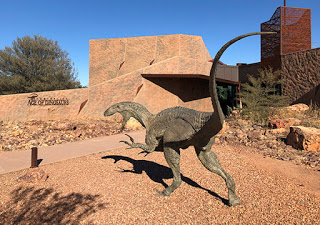
Australia, not the first country that comes to mind when you think of dinosaurs. It’s a massive, sparsely populate country and not the easiest place to explore away from the cities and regional towns. So it’s not that surprising that few dinosaur bones have been found here. There are plenty of fossils of plants, fish, seashells and just a few sites with small fragments of dinosaur bones. But nothing significant… until now. Australia has hit the world stage of dinosaur sites.
Chance Discovery
Pastoral farmer David Elliot, found what he thought may be dinosaur bones while mustering sheep on his outback station in 1999. And what appeared to be large boulders laying on the ground were indeed dinosaur bones, bones from a previously unknown dinosaur. Any new discovery always attracts attention and it wasn’t long before an organised dig was taking place on David’s station. But nothing was found. The bones he had found were identified as belonging to a Cretaceous sauropod, a plant eating dinosaur from around 95-million years ago and later nicknamed ‘Wade’.

David thought long about this chance discovery. He knew his land and the soils it was comprised from. He also knew of an unusual black soil that often appeared on the surface of his land. He decided to dig deeper and it wasn’t long before he discovered more bones. He also discovered an unusual soil cycle.
As soil dried and cracked during the dry season it provided a path for subsequent rain to filter down to the black soil layer. The black soil would dissolve and over many years rise towards the surface bringing small bone fragments with it. Heavier objects remained buried relying instead on erosion to expose them.
…And there was more

In 2005 David discovered bones in a new site at Belmont and uncovered one of Australia’s most complete dinosaurs. A further dig at Elderslie Station, near Winton, revealed two dinosaur skeletons together – Matilda, an enormous plant eating sauropod and Banjo, a razor-clawed meat eating theropod. Both were named in honour of local man Andrew ‘Banjo’ Paterson and his Waltzing Matilda song.
David was the driving force in getting a museum built to display and provide facilities for fossil preparation in Winton. In 2006, 1,400 hectares of land was donated by Peter and Carol Britton. The land included the ‘Jump-Up’, or mesa, and provided the ideal place for a natural museum overlooking the very fields where the dinosaurs we being unearthed. And with the aid of many donations, public, private and government supported, the Australian Age of Dinosaurs Museum opened to the public in April 2012. Five years later, with further expansion, Dinosaur Canyon was opened.
Scientific Names
So far three new species of dinosaur have been discovered here including Wade (Sauropod Wintonotitan wattsi, Matilda (Sauropod Diamantinasaurus matildae) and Banjo (Theropod Australovenator) and these are what is creating a big stir in the dinosaur scientific community. And would you believe there is also one named Qantassaurus intrepidus.
A must visit
I don’t want to spoil anyones future visit to the Australian Age of Dinosaurs by describing what we saw and experienced while there. All I would say is this is an absolute must when visiting this region. If you only have time to visit one place while near Winton, this has to be it.
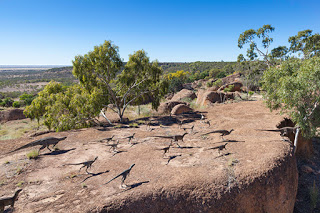
And if you really enjoy what you see and want to take part in a dinosaur dig yourself or help to prepare real dinosaur bones, you can. Australian Age of Dinosaurs welcomes volunteers. You may even get a new dinosaur species named after you!
We’re both tempted to have a go when we’re back in the region again.
 Discovery Down Under