

From small beginnings
Qantas is the second oldest airline in the world, the longest running and to date has the safest record of any airline company. It’s only crash occurred when one of its first aircraft was being delivered from the UK and, having just been built, crashed shortly after take-off on the way to Australia while still in England. Pieces of this aircraft frame are on display at the museum as well as details of the pilot who sadly died in the accident.
The Qantas story starts with the need for an air service to provide mail and transport services for Queensland and the Northern Territory and it’s from there that its name is derived – Queensland and Northern Territory Aerial Services Ltd. Originally formed in the outback town of Winton, Qantas moved to Longreach, which was more central to its intended service region. Its first passenger carrying aircraft, the Avro 504K was manufactured by AV Roe in the UK, makers of the famous WWII Lancaster Bomber, and went into service in January 1921. The two passengers sat in an open cockpit with goggles and a leather helmet while the pilot sat in front. It wasn’t until the 22nd of November the following year that the first scheduled service took place.

In 1924 Qantas started using the larger Dehavilland DH50 biplanes. With an enclosed ‘passenger cabin’, passengers no longer needed to wear a helmet and goggles but the pilot still remained exposed to the elements. Then in 1924 Qantas started building their own DH50 aircraft under license, examples of which are on display in the Hangar Museum.
1928 saw the world’s largest Aerial Medical Service form and from the beginning Qantas signed a contract to provide on-demand flights. The service is better known as ‘The Flying Doctor Service’.
In 1929 Qantas moved its expanding business operations to Brisbane but moved again in 1935 to its current location in Sydney. And from there the company grew from strength to strength introducing its first international flight to Singapore in 1935. A year earlier Qantas created a joint venture with British Imperial Airways to provide the first England to Australia route. Using the huge Short Empire Flying boats under the Qantas Empire Airways banner and based in Rose Bay – Sydney, Qantas’ first England to Australia flight touched down in Sydney on Christmas Eve 1937.
The Jet Age
Generations of larger propeller driven aircraft continued to carry the increasing number of passengers until 1957 when Qantas placed an order for seven Boeing 707-138 aircraft, which marked the start of the Jet Age in Australia. These were the first Boeing Jet aircraft to go into service outside of the USA. The 707 jets arrived 2-years later. The first service from Australia to the USA (San Francisco via Fiji and Honolulu) began in July the same year and was quickly followed by the first Australia to England flight via New York. In October a second route to London began, this time via India.
Boeing 707 – make an offer

With a long flight history and several owners, Qantas’ first Boeing 707 is on display and forms part of the Jet Tour that we were taking part in. This aircraft was used by the Jackson 5 after being sold by Qantas but later left to rot before the museum purchased it for the princely sum of 1-pound and 1-pence. It had once been valued at $50-million after a refit for a Saudi oil sheik.
Bring on the Jumbo
With 21 Boeing 707’s still in operation, Qantas placed its first order for the Boeing 747 ‘Jumbo Jet’ in 1967 and the first 747 service began in September 1971. Further orders were placed and in 1989 Qantas’ first 747-400 set a world distance record with a non-stop flight from London to Sydney in just over 20-hours and 18,001KM.
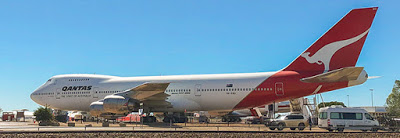
This Boeing 747-200, retired from the fleet, was donated to the museum. During its lifetime it had flown the equivalent of ten continuous years in the air. Though normally needing a 10,000ft runway, free of passengers the aircraft was just able to land and stop before reaching the end of the 8,000ft Longreach runway. The runway is too short for the aircraft to take-off and will never take to the skies again.
Then in 2008, Qantas took delivery of its first Airbus A380 aircraft – the world’s largest passenger carrying jet aircraft, which touched Australian soil for the first time on the 21st of September 2008.
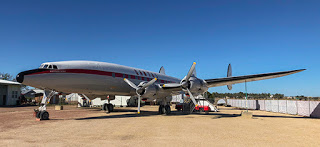
Aircraft also on display at the museum are one of Qantas’ DC3’s a mid-war Catalina and the beautiful ‘Connie’ Super Constellation, which is currently being prepared for display. Qantas has provided, engineers, painters and fitters to help restore this aircraft.
The museum’s internal display traces the airlines history with artefacts on show including a replica of the very first Qantas plane, an Avro 504K. Several aircraft engines as well as the famous Rolls Royce RB211 Turbofan engine are also displayed.
The Jet Tour is in addition to the museum entry fee but well worth it. It gives you close-up access to the aircraft on static display, an explanation of many of the external features of the 747 not normally seen – and lavatory waste is not dumped while the plane is in-flight!! A tour of the First Class cabin – a Qantas first, Business and Economy as well as the rear of the aircraft where the ‘Black Boxes’ are located – an Australian invention and they’re not black – and finally the flight deck and long-haul crew bunks. A similar tour of the Boeing 707 follows, which really goes to show how far things have changed compared to today’s modern aircraft.
Wing Walking with a difference
An additional tour option will see you sitting in the Captain’s chair on the 747 followed by a wing walk… safely secured of course. And, unlike the airshow wing walkers, you wont be taking-off on this one!
 Discovery Down Under