
I have to admit, being from the UK, I’d never heard of Bert Hinkler but the more I discovered today at the Hinkler Hall of Aviation the more I was surprised his name is not better known outside of Australia and Italy.
Born in Bundaberg in 1892, Herbert John Louis Hinkler worked briefly in the sugar mills and foundry at Bundaberg but his real passion lay in aviation, which, despite its dangers, had been actively encouraged by his mother from an early age. He took a correspondence course in mechanics giving him the grounding he needed to build his own aircraft.

Bert built two gliders, the second of which was based on his personal study of the Ibis, a common long-billed bird here in Australia. This led to his first successful flight from the beach now called Mon Repos, just 7KM from our site of Bargara. This short flight was the first recorded manned flight of an aircraft in Australia.
In 1913 Bert moved to England and found work with Sopworth Aircraft who had just started to build biplanes for military use. Shortly after he joined the Royal Naval Air Service. From his service with the Navy, where he first learnt to fly powered aircraft, he soon transferred to the Royal Airforce and was stationed in Italy for the remainder of the First World War. In February 1928 Bert made the first solo flight from England to Australia in just 16-days and breaking five aviation records on the way.
Following years saw Bert as a leading test pilot in England working for an experimental division of A.V. Roe, manufacturer of the famous Lancaster Bomber, before moving to Canada where he began planning a light aircraft flight around the world. In the meantime he attempted a second England to Australia flight leaving Heathrow during the Winter of 1933. It is believed mechanical failure or bad weather resulted in a crash in the Appenine mountains of Italy. He survived the initial impact but died shortly after at the scene. His body wasn’t discovered until the Spring during the snow melt. He was buried in Florence with full military honours on the order of Mussolini.
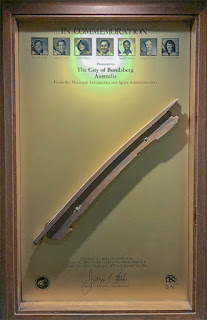
He received numerous medals, awards and prizes during his flying career but the thing that really amazed me was an event that took place on January the 28th 1986, long after his death.
Space Shuttle Challenger
You may wonder what NASA’s Space Shuttle has to do with our Mr Hinkler. It is a little convoluted but stick with me. The Hinkler House Memorial Museum and Research Association invites guest speakers to present a lecture to the Association’s members. In 1985 one such speaker was NASA Astronaut Don Lind, having just flown as Mission Specialist and Payload Commander on Space Shuttle Challenger flight STS-51-B. As a thanks for the lecture the Association presented Don with a small wooden section of wing spar from Bert’s 1911 glider.
Now, Don Lind was a friend of fellow Astronaut, Shuttle Pilot and later Shuttle Commander, Dick Scobee. As Dick was due to fly as Shuttle Commander the following January on flight STS-51-L, Don had asked Dick to carry the glider fragment into space to honour the memory of Bert Hinkler’s aviation achievements and contribution to human flight. As fate had it, flight STS-51-L was launched with the knowledge that the icy conditions were unprecedented and may cause issues with the gas seals on the solid rocket boosters. Lind, on his first and only space flight, and Scobee, had flown previously on Challenger but this flight, Scobee’s second, was to end in tragedy. Just 73-seconds after lift-off, Challenger suffered a catastrophic failure exploding 46,000ft above the South Atlantic Ocean. None of the seven crew onboard survived. The fragment of Bert’s glider never made it into space. But that wasn’t the end of the story.
A Survivor
Incredibly, the fragment of glider survived the explosion and was discovered among the 15-tons of wreckage recovered from the ocean. In 1987 Dr June Scobee, Dick Scobee’s wife, visited Australia on behalf of NASA and presented the mounted fragment of Bert’s glider to the Association from where it began. It is now on display at the Hinkler Hall of Aviation in Bundaberg.

Bert Hinkler’s name lives on in aviation having his name carried on one of Qantas’ Airbus A380 aircraft. In fact so strong is Queensland’s admiration for Mr Hinkler that his entire UK house was demolished brick by brick and transported half way around the world and rebuilt in the Bundaberg Botanic Gardens where the Hinkler Hall of Aviation now stands.
Regarding the house relocation, I have to confess, this one puzzles me.
 Discovery Down Under