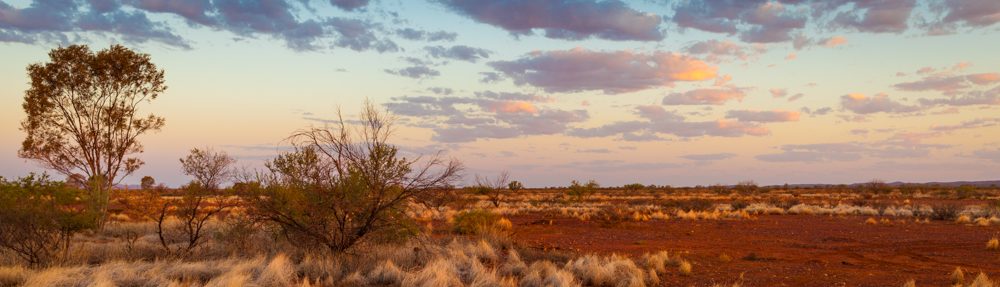
Today was an early start rising with the sun at 6am. A new adventure awaits us on Fraser Island, the world’s largest sand island, just off the coast of Hervey Bay.
Peter from Fraser Island Explorer Tours picked us up along with five others and took us to the ferry terminal at River Heads. Forty-five minutes later and were boarding our 4WD tour bus and heading on the rough sand road to Central Station approximately half way across the island.

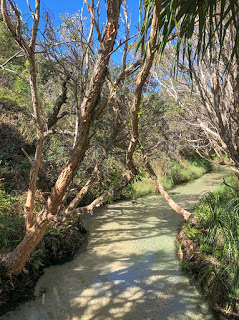
The name, Central Station, is a little misleading giving the impression of a transport hub but it is anything but. Originally an early settlement for loggers it quickly grew adding a school for growing families. Now little remains of the settlement but it is still home to some amazing trees, Kouri’s, Satinay and Hoop Pine rising perfectly straight towards the sky. We took a short but visually stunning walk from here to Wanggoolba Creek with its crystal clear water trickling under the shade of the trees and ferns, some that were around during the age of the dinosaurs. We were also treated to the early bird song, which was the only thing that broke the silence of this beautiful place.
As we drove across the island there were very distinct changes to the native vegetation. From the west are the large trees and dense scrub but as the landscape becomes increasingly exposed to the salt air from the prevailing south-easterly winds, the trees become smaller, ferns and bracken become more common and eventually grasses, low scrub and banksias take over as we reached the coast.
The Road!
Visitors to the island will very quickly realise this is the domain of 4WD cars and ones with very strong suspension and low tyre pressures to handle the very rough sand tracks. It was far rougher than either of us had expected and apparently the tracks were in pretty good condition right now. Our 4WD bus was designed to handle this kind of punishment being raised high off the ground and equipped with independent suspension but it was still very rough at times. The wearing of seat belts is compulsory and with very good reason.

Once we had reached the east coast at Eurong we headed north on the beach highway of 75-Mile Beach. It’s an amazing location with crashing waves to our right, bush to our left and a sand beach as far as you can see in front and then much further again. It’s a policed ‘road’ with a maximum 80-KMH limit and where normal road rules apply, so don’t be surprised by a random breath test.
We weaved around the firm sand, surf, dips and rocks along with several other 4WD vehicles passing in both directions, mostly on the correct side. And where the tide, deep creek or rocks blocked our way we cut inland over some pretty steep tracks.
Bingo a Dingo!
Pete had been talking to us about the infamous Dingo native to Fraser Island and especially the idiots who, despite all the warning signs, feed them scraps so they can stroke them or have their photo taken with them. These are not pets, they aren’t even dogs as we know them – though they look much like them. These are wild, highly intelligent and often dangerous animals that with the temptation of food may attack. Perhaps worse still, they will get accustomed to being fed and will lose any fear of humans thereby posing a greater danger to us and often leading to the animal’s destruction.

And right on queue, there was a Dingo walking along the beach. Pete circled the bus so we could all take a photograph from a safe distance.
Up a Creek but no paddle
Further up the coast was our first stop at a spot called Eli Creek. The creek is one of many that fresh filtered water bubbles up from the underground aquifer and onto the beach but this one is particularly gushing with 4-million litres of pure, fresh water heading out to sea every hour. A boardwalk has been constructed so you can walk along the creek and then float back in the current or paddle back to the beach. It was a little chilly in the shade this morning so a quick digit test of the water and a photo had to suffice. During the high season, apparently, it’s crowded here with often 6-coach loads of tourists all wanting a dip. We were lucky being late in the season, it was almost deserted.
It was time for a morning cuppa and Pete had prepared drinks and pastries for us including what looked like a ghost shaped chocolate chip biscuit. I was corrected, held the right way up it was a Dingo’s footprint. Hopefully the dark bits really were chocolate. Either way, they were delicious.
Fancy a Flight?
Just as we boarded the bus we saw two light aircraft that had just landed on the beach. Fraser Island is one of only two licensed commercial beach flight operations in the world, the other being Barra in the Outer Hebrides off the West coast of Scotland. Pete took us over to one of the pilots to give us a chat about the flights they run over the island. Catherine was immediately hooked and so were the rest of us, all seven of our tour. Within 15-minutes we were racing down the beach and up into the air on an unexpected extra adventure.

It was a small light aircraft with just 8-seats including our pilot, which gives a truer flying experience than a commercial airliner complete with tight turns, engine noise and quicker manoeuvres. Similar to my first flight in a 4-seat Piper Cherokee, almost as soon as you take-off there is very little sense of forward motion and you feel as if you are just hanging there.
Our flight climbed to 1500ft and turned briefly over the sea looking for any dolphins, turtles, manta rays, stingrays or whales, which were just starting to pass Hervey Bay on their annual migration. Nothing this time so we turned inland over the enormous forests with a clear view of the whole island, all 123-KM of it from north to south and 22-KM east to west. Then, turning again to fly over several of the perched lakes, remote 4WD tracks and sand dunes. And back over to the sea again banking steeply side to side looking for wildlife in the crystal clear water.
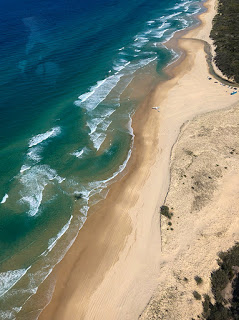
A dolphin and sting rays were spotted on Catherine’s side but nothing from where I sat. We also did a pass over the Maheno shipwreck that we would soon be seeing at ground level. Finally one last circle over the sea before lining up for a smooth landing on the beach a little further north at the Pinnacles, which was our next intended stop where Pete was already waiting with our Bus. A great experience and absolutely recommended to see the island from a different angle.
The Pinnacles
These multi-coloured sand cliffs have been eroded over time to create pinnacle like sculptures. It is a place of significance for the local Aboriginal mob as a women’s place and the elders ask that you don’t walk too close or climb any of the structures. This is something that we strongly respect and is surely the best way to preserve what is here. Sadly not everyone feels the same way. The same ‘no climb’ policy at Uluru was requested and is now compulsory. We had both climbed Uluru in 2000, an amazing experience, but not something we would do again out of respect… and it’s a tough climb too!
Maheno Shipwreck
We had perfect weather and a good tide for our next stop as we headed back south to the SS Maheno shipwreck. This huge rusting wreck looks spectacular against the deep blue sky offering countless photographic opportunities. Again, being out of season helped with few people around other than ourselves. It would have been great to have taken a photograph with the drone but it was quite windy and our time here was limited.
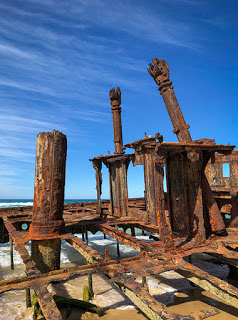
The ship has an interesting history starting out as an ocean liner operating between Australia and New Zealand from 1905 to 1935-years. During the First World War she served as a Hospital Ship before being swept ashore during a cyclone in 1935. Strangely the Australian Defence department list the wreck as a site of unexploded ordnance though nothing has ever been found here. There are stories, however, that the Japanese bought the ship to recover valuable metals before trying to tow it offshore and that Australian aircraft had bombed the ship to prevent it falling into enemy hands as Japan aggressively expanded its operations in the Pacific.
Back down the coast to Eurong for a lovely lunch before a very rough drive to Lake McKenzie. Now when I say the road is very rough that is perhaps an understatement. There is no way I would want to drive a vehicle smaller than ours with its high clearance and independent suspension, even the driver’s cab is isolated from the body of the bus where we sat.
High traffic to this popular spot has created large holes, ridges and gullies and the National Park want to keep it this way! They say there isn’t enough sand to fill the holes. Really? On the world’s largest sand island? Where do they think the sand has gone that once filled the holes? However, there is ‘some’ logic to this. Improving the road could lead to easier access and encourage more visitors. It could even attract vehicles that aren’t true 4WDs and cause all sorts of road damage and blockages on the single track roads.
Lake McKenzie
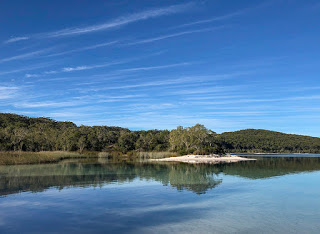
But, bad road apart, Lake McKenzie is absolutely worth the visit… out of season when it’s not crowded. The enormous fresh water lake is only here because decaying vegetation has settled on the lake bed and gradually worked its way through the fine sand to form a firm, water retaining rock-like layer know as coffee rock. It is the sand, though, that makes this place special. Each grain of powder fine, white sand is round rather than the normal irregular shaped beach sand. It not only makes it look whiter it is also fine enough to use as a polish, though I wouldn’t want to try it on anything valuable.
Popular with swimmers, it was a little cool today with a breeze coming off the sea but I could imagine a dip here during summer would be amazing. Still, the temperature didn’t put-off a group of younger visitors that arrived before us.

At least the return drive to the ferry wasn’t quite as rough and waiting for us was a courtesy drink at the Sunset Bar of the Kingfisher Resort. A perfect ending as we watched the sun setting over the mainland and a coffee to take on to the ferry.
A great experience, beautiful weather, a great tour guide, stunning scenery and the unexpected flight. Worth every cent. And to think we were hesitating whether to visit the island or not.
 Discovery Down Under