We’re on the move again leaving Dubbo behind and heading for our next stop at Coonabarabran – a Dark Sky town. First though is a planned visit to Jayco in town for a couple of issues with our caravan to be fixed, the main one being a safety recall for the gas heater, which is now very much needed with the cold nights we are experiencing. We had tried to get the heater looked at by Jayco in Orange but after three promises to check it, a denial there was such a recall and two no-shows we gave up. And our caravan site was directly behind Jayco’s service centre!
Conjuring up a brew
While our van was in the Dubbo workshop we enjoyed a coffee and a bite to eat at our latest favourite eatery – The Alchemy – just around the corner. Another one for our highly recommended list. And in just a couple of hours our van was ready to hit the road again. Excellent service and very helpful staff at Jayco Dubbo.

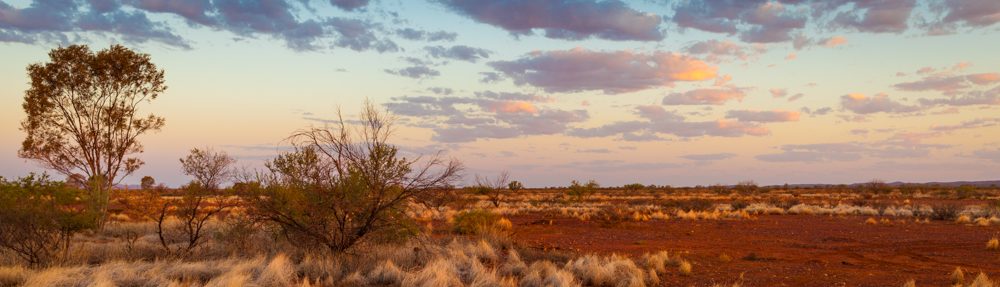
Shortly after leaving Dubbo we were surrounded by a vast, flat expanse of bone dry farmland. The only colours being the pale green leaves of the gum trees and a parched red soil. Where verdant grass pasture should be there was little but dry grass for the sheep and cattle to eat relying instead on feed and supplies of straw and hay transported by road trains into the region. It is a sad sight and one in desperate need of sustained rainfall.
The roads here are long and straight with just rest stops and small towns breaking the sameness of the surroundings. Strangely, though, it is an interesting and enjoyable drive, a change of driving style, more relaxing, and much smoother.
Coo-ee!!
We made our first stop at Gilgandra, a small township on the A39 just short of halfway to our destination – Coonabarabran. Gilgandra is known as ‘The Town of Windmills’ for its windmill collection showing the development over fifty-years of this important technology, one that was vital for the region to develop its farms.
Gilgandra is more commonly renowned for its ‘Coo-ee March’, also known as the ‘Gilgandra Snowball’. In 1915 a group of 20-men set off from Gilgandra to Sydney determined to enlist for the war effort. As a recruitment drive the group eventually totalled 300 by the time they reached Sydney triggering many similar marches from within New South Wales and Queensland.
Leaving Gilgandra behind and the journey gets even more interesting as the straight roads end and we see our first view of the Warrumbungles – a large range of volcanic mountains rising straight out of the flat plains. It’s a surprise both from its sudden appearance but also its range of round-topped peaks. At the same time the road becomes increasingly hilly and eventually makes a steady but steep climb over the mountains before dropping down into the town of Coonabarabran, widely known as Australia’s top location for astronomy.
It is no coincidence that we chose Coonabarabran as a place to visit on our trip and its astronomy background. We had hoped to do a night viewing at one of the observatories and we had managed to book with the Warrumbungle Observatory for tonight and it was to continue, as today, with a completely cloudless sky. We knew it was also going to be cold and after parking and setting up the van we wrapped-up and headed out of town to the observatory.
Igloos in the Outback?
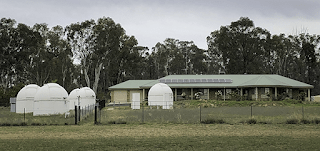
Being very wary of any wildlife that may run out in front of us, we drove well below the speed limit keeping an eye out for the observatory. What we hadn’t expected was its location and size. Looking more like a group of igloos in someone’s front paddock were the five miniature white domes housing a variety of telescopes. Equally unexpected was what we saw when we got out of the car and looked upward – millions of stars and the huge expanse of the Milky Way right above us. We had both seen the Milky Way while at the Grand Canyon in America but here was a complete lack of light pollution from street lights or neighbouring towns, this was a true Dark Sky location and the reason for some of Australia’s biggest and most important optical telescopes to be built here.
We joined a small group of visitors in the dark and listened to a presentation from our astronomer guide as he pinpointed many of the stars and galaxies that we could clearly see above and around us. Once your eyes have adjusted to the dark they become a million times more sensitive and you soon realise the sky isn’t really all that dark at all, the whole sky glows with the light of countless billions of stars.
Eagerly we made our way to four telescopes that had been setup for us pointing to well known stars and the Large Magellanic Cloud. What looks like a fuzzy pale cloud to the eye becomes a staggering mass of stars through the telescope and we were only looking at a tiny portion of it. Believed to contain at least 30-billion stars we were looking at light that has taken 158,200-years to reach us. Many of those stars will have since faded away but it could be thousands or hundreds of thousands of years before we would know.

Over the next 45-minutes the telescopes were pointed at increasingly interesting stars and galaxies including the famous Sombrero galaxy. But the highlight of the night is the use of the largest telescope under the protection of its $80,000 dome aimed at Eta Carinae and having photos of it taken with our cameras attached to the telescope. And I forgot to put a memory card in my camera!! Fortunately Catherine had one to hand that I could use.

170-years ago Eta Carinae underwent a titanic blast that at the time made it the second brightest star in the Milky Way but has puzzled astronomers ever since. Somehow the star survived its outburst and remains one of the brightest and most massive stars in our galaxy. It is 5-million times brighter than our own sun.
Once everyone had left, and all the car lights were gone, I got the chance to take a couple of long exposures of the Milky Way with a 24mm lens, which turned out to be much better than I had expected.
It was a fascinating though bitterly cold night but absolutely worth it.
 Discovery Down Under