Today would be the first time we’ve driven our new Discovery 5 off-road. I have to admit to being a little apprehensive but Graham, who we did the tow training with, assured us we won’t damage the car. And he should know – he is also one of the 4WD trainers.
The course is complimentary for new Land Rover owners and designed to demonstrate firsthand what their cars are capable of. Our nearest course location was just outside Lithgow in New South Wales.
So it was an early start again to drive over the Blue Mountains to be at the training site for 8.45am, but the roads were quiet and we arrived with plenty of time to spare. Julie, our host, had laid out drinks and snacks and fIrst order of the day was to grab a much needed coffee while we waited for the other attendees to arrive.
We had met Julie previously when we booked our Tow course but Julie and her husband John are also the creators and presenters of the Australian Towing Guide DVD supplied with the course.
As the remaining trainees arrived it was quite a sight to see so many new Land Rovers gather in their natural bush surroundings. Range Rovers, Velars, Evoques and Discovery’s, all so clean and shiny, at least for now!
Meeting the Team
Our trainers for today were Tim & Truskie and they introduced themselves and the objectives of the course as we all gathered around. Part of the course was to be held on John & Julie’s bushland property and the remainder in Marrangaroo National Park just a short drive away.
First off was an introduction to Land Rover’s typical features common across the range along with many useful tips such as the correct ‘command position’ for the driver for maximum safety, changes to the hand position on the steering wheel to prevent severe injury from airbag deployment and keeping windows fully open or fully closed when off-road to prevent sideward head injury. An unknown to us was the way the car adapts to the way it is driven over time, so if something ‘feels’ different from when we first drove the car then it probably really is different.

Terrain Response 2 is the name given to Land Rover’s all surface traction control system, which enables the vehicle to drive over just about any type of surface whether it be gravel, sand, snow, mud, rock or, of course, the black stuff.
Each of the terrain modes were explained to us, what to expect when selected and when to use them. Left in the Auto position the car’s electronics will switch to whatever mode it decides is most suitable for the current road or track conditions. But switching manually is more engaging for the driver and won’t lead to any surprises if the throttle response unexpectedly becomes more aggressive as it does for sand. Hill Decent mode would become useful later with automatic brake control allowing us to concentrate on steering the car downhill on slippery or loose gravel tracks. And perhaps most importantly was Truskie’s advice for using Low-Range transmission, which would provide the torque when needed at lower wheel speeds over difficult terrain.
It was time to hit the dirt
Tim had ‘parked’ the Velar on a hump leaving one of the rear wheels high in the air and joked that it was to change a wheel – I’m not sure that would be a good idea!! We hadn’t realised we would be ‘wheel-up’ on the course, at least so soon, but we were up for the adventure and knew the car was designed for this kind of terrain. This was just the first obstacle of the course we were about to tackle. Tim and Truskie took us through each obstacle as we walked around the circuit; entry and exit angles speed and Terrain Response modes.

We had all been issued with a UHF radio that Truskie used to guide us through each circuit trying out different Terrain modes, which were far more noticeable than expected but gave good practical experience of the effects of each. Some modes would alter the throttle response while others would increase the ride height or lock the centre differential.
On each circuit we became more confident and tried differing approach angles to confirm just how good the clearance was on each of our vehicles. The Range Rovers and Velars had noticeably less suspension articulation than the new model Discovery’s that tended to tip a little more over some of the humps but none of the cars ‘bottomed out’ at any point.
One last test was Hill Decent control as we headed down a small incline back to our meeting point at the house. You could feel the brakes working to keep the car’s speed down with a little scrubbing of the tyres. The Cruise Control works in conjunction with the decent control system to set the required downhill speed. Another feature to add to the many to remember.
Back at the house and Julie had prepared us a delicious spread and homemade cakes – not forgetting the apple pie and ice cream!!
Heading off-road
In the afternoon we left the property for a short drive to the Marrangaroo National Park to put all this morning’s training into practice.

Just within the park boundary we pulled over while Truskie explained what we were about to do and to be sure we keep in contact with the vehicle behind to make sure they followed the same route. We soon saw just how easy it would be to lose your way with tracks heading-off in all directions and no clear view through the trees.
We started on a crushed limestone road, which soon narrowed to a dirt track and becoming increasingly bumpy. Our Discovery handled the road with ease and remained surprisingly smooth despite keeping the tyres at standard road pressure. This was the ideal track that changed surface as we progressed giving us plenty of opportunity to try out each of the Terrain Control modes.
First Casualty
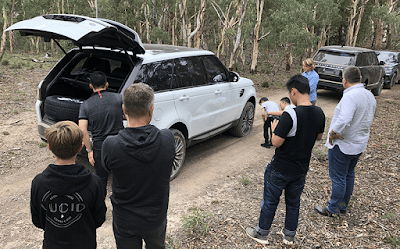
Fitting larger wheels with low-profile tyres may not have been the best option for use off-road and a branch flicked-up from the track proved a point – a sharp one! It would be an expensive one with an unrepairable puncture for the Range Rover.
Tim wandered off into the bush and returned with a straight stick, which he placed alongside the passenger-side front wheel arch. He was checking the height with the good tyre to compare with the spare, the factory standard wheel and tyre. Mismatched tyres and wheels can lead to issues with the car’s terrain control system. Dissimilar sizes results in different wheel rotation speeds, which can indicate that the faster wheel is slipping when in reality it isn’t. When a wheel slips the terrain control system will apply more power to the opposite wheel, in this situation not what you want.
Back in action we took several turns through the park with each providing a different challenge for us; narrow gaps between rocks or trees, descents that got the traction control system going and climbs along a ridge-line where many large trees had fallen during a recent storm. Truskie advised that there was plenty of room to pass between the trunks but they looked much closer than they must have been.
Volunteers anyone?
Then came our first of two water crossings over the Cox’s river. Tim and Truskie explained the correct procedure to approach water, ideally wading across checking the current, depth and hidden obstacles that could leave the car stranded. The new Discovery had the advantage among the convoy of the greatest wading depth of 900mm but it wasn’t required on this crossing. Tim advised that water does not compress and entering the water at speed could easily damage the front of the vehicle. Slow and steady was the safe method and stopping briefly on the opposite bank lets any water drain from the underside.
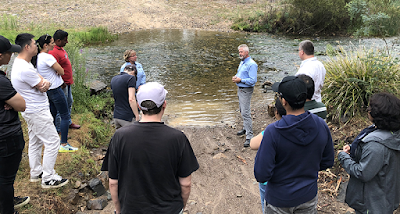
Shortly after was our second crossing, again not deep but wider and deeper sections to the right, which needed to be avoided. The remainder of the track varied between gravel, loose rock and ruts of various depths giving us a good mixture of surfaces to gain experience on – nothing too severe even for complete novices.
Re-grouping we joined the main track in and out of the park while Truskie advised we should switch out of low-range and back to road height ready to head back. We were sorry to leave the track and would happily have gone around again but a cup of tea and cakes were waiting for us at the training centre and a recap of today’s event.
We shared our experiences with several of our fellow trainees swapping email addresses. Who knows we may bump into each other at some point on our adventures. We all gave a big thank you to our hosts John and Julie and our trainers Tim and Truskie for an excellent fun, educational and very memorable day.
Recommendations? Absolutely! Although the course is complementary for new Land Rover owners it is also available for purchase via Land Rover’s website. Give it a go, you won’t regret it.
 Discovery Down Under